
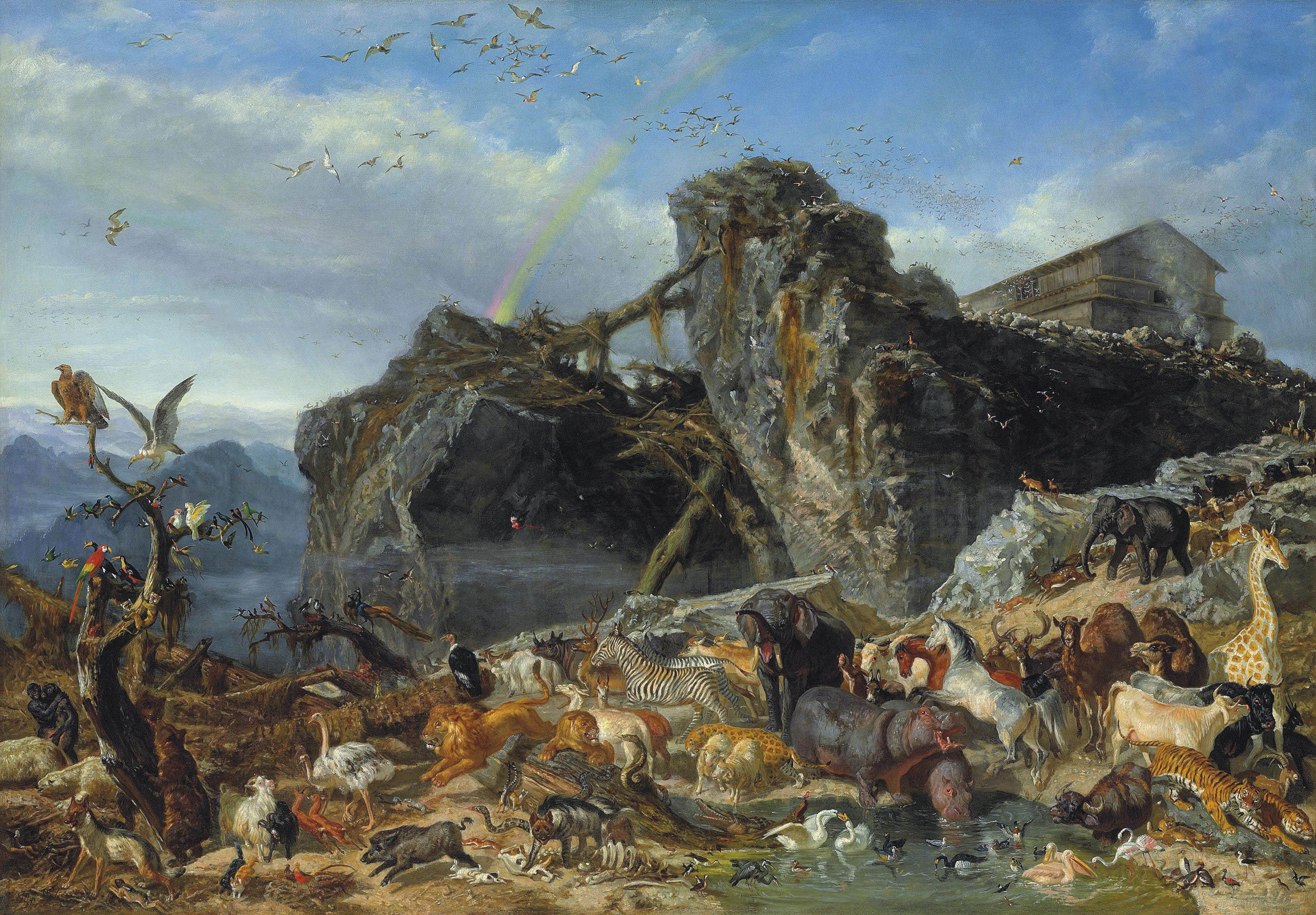
Noah and the Flood
Personal Context
Once, when I was visiting my parents while I was a graduate student at Brandeis University, one of their friends asked me about the archaeological finding that proved the historicity of Noah’s ark – he read about it in a magazine. I knew next to nothing about the finding so I tried to sidestep all his questions. It didn’t help that my professors never discussed the historicity of any event prior to the rise of the United Kingdom under King Saul and David. But even that was under scrutiny and therefore, questionable.
My parents’ friend bombarded me with questions, “where is it exactly?”, “what did they find?,” “how would the flood be dated based on the findings?”, etc. When I couldn’t answer any of his questions, he seem confused and started doubting whether I was attending a legitimate school. Shouldn’t a graduate school that teaches the Bible know the details of the Bible, especially something as universal as Noah’s flood? How could a student of the Bible not know the basics of the Bible? If I shared anything about the way we studied the Bible with him, he probably would have thought we were a bunch of atheists/agnostics/heretics, which would have been mostly true but not favorably received.
I did not grow up in a community that questioned anything in the Bible so we believed everything that was in the Bible. The story of the flood, Noah, and all the animals was a historical account! No ifs or buts about it. Isn’t that why we have the rainbow after each rainstorm to remind us – it is not an “optical phenomena” but a sign of the promise God made to Noah and to all of us. God promised that God would never destroy the world with a flood ever again. Pinky swear or more like a blood oath. But we never got beyond the facts of the story. What really was the point of the story? How was the story told and to what end was the story shared with the ancient audience?
We will be digging a little deeper into the story to understand the way it plays into the theology of the different authors, the Priestly and Yahwist sources. What did they want to share with their audience to what end? Without question, they had an agenda in telling the story and that is what we need to explore. As for the question of its historicity, it may or may not have happened. We can never prove or disprove and therefore, I sometimes find it to be a pointless debate. If it happened, then does it really prove the Bible to be true? Which version of the story? If it didn’t happen, then does it prove that the Bible is false? False in what way? So the question is, “Is the historicity of the event more important than the “why” of the story, especially if we have no way of proving definitively as to whether or not Noah really existed?” What will help us understand the function of the story? That is what we will be exploring.
Ancient Context
Introduction
The story of Noah and the flood has become the paradigm for modern scholars to argue for the documentary hypothesis and Mesopotamian influence on biblical stories. However, in the endless discussions over multiple authorship and drawing parallels to ancient Near Eastern sources, we have lost the meaning of the stories. This is not to take away from the importance of scholarly discussions; we will include them here. But many times, we fail to provide unique insights into the significance of the differing perspectives of the ancient authors. How did the Priestly source explain the reason for the flood as compared to the Yahwist or the Mesopotamian story of the flood? How does the explanation reflect their theologies or perhaps may have failed to explain the meaning of a major disaster? What is the significance of the sacrifice (Yahwist source) as opposed to the covenant (Priestly source)? And what on earth is going on with Noah and his son, Ham? How has this problematic story been used to justify the continual oppression of people? So much more than a lifeless academic analysis because the questions of why shed a more interesting light on the story. There may be limits on the authorial perspectives as they try to understand their God within their context but the limits reflect the humanity of the biblical authors.
Mesopotamian Flood Story
The flood narratives, the Priestly and Yahwist sources combined, is very similar to the Mesopotamian flood story which is present in the Atrahasis Epic. If we were to date the stories, without question the Epic of Atrahasis was earlier than the biblical narrative. The best preserved version of the epic is dated to 1650-1700 BCE (which does not reflect the dates of some of the older versions-tablets) whereas the earliest source of the Bible (i.e. Yahwist or the Elohist) may be at best dated to 1000 BCE (highly conjectural). Therefore, most scholars would agree that the biblical authors were influenced by the Mesopotamian story of the flood.
Summary of the Mesopotamian Flood Story
The Mesopotamian story of the flood is recorded in two distinct places, the Atrahasis Epic and the Epic of Gilgamesh (Tablet XI). Tablet XI of the Epic of Gilgamesh does not contain a different version of the flood but draws from the story as it is outlined in the Atrahasis Epic. In the story, the god Ea warns Utnapishtim/Atrahasis (“wide of ears” – wisdom) of the imminent flood which Enlil had pronounced against humankind because of the noise. Utnapishtim builds a boat, takes everything he owned and his family, and saves the animals who come to him. On the 7th day after the rain stops, which raged for 7 days (so 14 days total), Utnapishtim sends out the dove. When the dove returns, he then sends out the swallow which also returns, and finally he sends the raven, which does not return.

Utnapishtim opens the boat and frees all the animals except for a sheep which he sacrifices to the gods. The gods flock to the offering at which point Beletili points to her lapis lazuli necklace which functions as a reminder of the devastation of the flood.
Epic of Gilgamesh (Tablet XI), pp. 46-47
When a seventh day arrived
I sent forth a dove and released it.
The dove went off, but came back to me;
no perch was visible so it circled back to me.
I sent forth a swallow and released it.
The swallow went off, but came back to me;
no perch was visible so it circled back to me.
I sent forth a raven and released it.
The raven went off, and saw the waters slither back.
Then I sent out everything in all directions and sacrificed
(a sheep).
I offered incense in front of the mountain-‐ziggurat.
Seven and seven cult vessels I put in place,
and (into the fire) underneath (or: into their bowls) I poured
reeds, cedar, and myrtle.
The gods smelled the savor,
the gods smelled the sweet savor,
and collected like flies over a (sheep) sacrifice.
Just then Beletili arrived.
She lifted up the large flies (beads) which Anu had made for
his enjoyment(!):
‘You gods, as surely as I shall not forget this lapis lazuli
around my neck,
may I be mindful of these days, and never forget them!
The gods may come to the incense offering,
but Enlil may not come to the incense offering,
because without considering he brought about the Flood
and consigned my people to annihilation.

Observations
One might argue that the flood was universal and therefore not surprising for different cultures to have their own version of the cataclysmic disaster. As a result, it does not necessarily follow that the biblical narrative was influenced by the Atrahasis Epic; they may be independent stories. However, given the striking similarities, it would be safe to assume that the biblical authors were aware of and borrowed from the Mesopotamian story. For example, both Utnapishtim and Noah sent out birds thrice to check to see if the ground was dry; both offered a sacrifice to the gods/God; and the rainbow functioned as a reminder of the promise not to destroy humankind with a flood. The question is not whether the biblical stories were influenced by the Mesopotamian story, but rather we need to explore what was borrowed, changed, and added to their stories. This is where we should focus on our attention. How did they use the elements to extrapolate on their own theology?
Sources/Authors
Within the flood narrative, scholars have been able to trace two distinct sources. Here, more than anywhere, it is difficult to overlook the apparent contradictions, one of the key reasons behind the documentary hypothesis:
- Number of animals
- Number of days of the flood
- Number of days in the ark after the flood
Despite the stark differences, the two sources were intertwined as if it was one story. The question was not if there are two sources, but what in these two sources was distinct and how do the differences speak to the overall themes of the sources. To carefully examine the way in which the differences speak to their theologies, I have delineated the scholarly separation of the two sources:
6:9
This is the account of Noah and his family.
Noah was a righteous man, blameless among the people of his time, and he walked faithfully with God. 10 Noah had three sons: Shem, Ham and Japheth.
11 Now the earth was corrupt in God’s sight and was full of violence. 12 God saw how corrupt the earth had become, for all the people on earth had corrupted their ways. 13 So God said to Noah, “I am going to put an end to all people, for the earth is filled with violence because of them. I am surely going to destroy both them and the earth. 14 So make yourself an ark of cypress wood; make rooms in it and coat it with pitch inside and out. 15 This is how you are to build it: The ark is to be three hundred cubits long, fifty cubits wide and thirty cubits high.16 Make a roof for it, leaving below the roof an opening one cubit high all around. Put a door in the side of the ark and make lower, middle and upper decks. 17 I am going to bring floodwaters on the earth to destroy all life under the heavens, every creature that has the breath of life in it. Everything on earth will perish. 18 But I will establish my covenant with you, and you will enter the ark—you and your sons and your wife and your sons’ wives with you. 19 You are to bring into the ark two of all living creatures, male and female, to keep them alive with you. 20 Two of every kind of bird, of every kind of animal and of every kind of creature that moves along the ground will come to you to be kept alive. 21 You are to take every kind of food that is to be eaten and store it away as food for you and for them.”
22 Noah did everything just as God commanded him.
7:6
6 Noah was six hundred years old when the floodwaters came on the earth.
7:11
11 In the six hundredth year of Noah’s life, on the seventeenth day of the second month—on that day all the springs of the great deep burst forth, and the floodgates of the heavens were opened.
7:13-16a
13 On that very day Noah and his sons, Shem, Ham and Japheth, together with his wife and the wives of his three sons, entered the ark. 14 They had with them every wild animal according to its kind, all livestock according to their kinds, every creature that moves along the ground according to its kind and every bird according to its kind, everything with wings. 15 Pairs of all creatures that have the breath of life in them came to Noah and entered the ark. 16 The animals going in were male and female of every living thing, as God had commanded Noah.
7:18-21
18 The waters rose and increased greatly on the earth, and the ark floated on the surface of the water. 19 They rose greatly on the earth, and all the high mountains under the entire heavens were covered. 20 The waters rose and covered the mountains to a depth of more than fifteen cubits. 21 Every living thing that moved on land perished—birds, livestock, wild animals, all the creatures that swarm over the earth, and all mankind.
7:24-8:5
24 The waters flooded the earth for a hundred and fifty days.
8 But God remembered Noah and all the wild animals and the livestock that were with him in the ark, and he sent a wind over the earth, and the waters receded. 2 Now the springs of the deep and the floodgates of the heavens had been closed, and the rain had stopped falling from the sky. 3 The water receded steadily from the earth. At the end of the hundred and fifty days the water had gone down, 4 and on the seventeenth day of the seventh month the ark came to rest on the mountains of Ararat. 5 The waters continued to recede until the tenth month, and on the first day of the tenth month the tops of the mountains became visible.
8:13-19
13 By the first day of the first month of Noah’s six hundred and first year, the water had dried up from the earth. Noah then removed the covering from the ark and saw that the surface of the ground was dry. 14 By the twenty-seventh day of the second month the earth was completely dry.
15 Then God said to Noah, 16 “Come out of the ark, you and your wife and your sons and their wives. 17 Bring out every kind of living creature that is with you—the birds, the animals, and all the creatures that move along the ground—so they can multiply on the earth and be fruitful and increase in number on it.”
18 So Noah came out, together with his sons and his wife and his sons’ wives. 19 All the animals and all the creatures that move along the ground and all the birds—everything that moves on land—came out of the ark, one kind after another.
9:1-28
9 Then God blessed Noah and his sons, saying to them, “Be fruitful and increase in number and fill the earth. 2 The fear and dread of you will fall on all the beasts of the earth, and on all the birds in the sky, on every creature that moves along the ground, and on all the fish in the sea; they are given into your hands. 3 Everything that lives and moves about will be food for you. Just as I gave you the green plants, I now give you everything.
4 “But you must not eat meat that has its lifeblood still in it. 5 And for your lifeblood I will surely demand an accounting. I will demand an accounting from every animal. And from each human being, too, I will demand an accounting for the life of another human being.
6 “Whoever sheds human blood,
by humans shall their blood be shed;
for in the image of God
has God made mankind.
7 As for you, be fruitful and increase in number; multiply on the earth and increase upon it.”
8 Then God said to Noah and to his sons with him: 9 “I now establish my covenant with you and with your descendants after you 10 and with every living creature that was with you—the birds, the livestock and all the wild animals, all those that came out of the ark with you—every living creature on earth. 11 I establish my covenant with you: Never again will all life be destroyed by the waters of a flood; never again will there be a flood to destroy the earth.”
12 And God said, “This is the sign of the covenant I am making between me and you and every living creature with you, a covenant for all generations to come: 13 I have set my rainbow in the clouds, and it will be the sign of the covenant between me and the earth. 14 Whenever I bring clouds over the earth and the rainbow appears in the clouds, 15 I will remember my covenant between me and you and all living creatures of every kind. Never again will the waters become a flood to destroy all life. 16 Whenever the rainbow appears in the clouds, I will see it and remember the everlasting covenant between God and all living creatures of every kind on the earth.”
17 So God said to Noah, “This is the sign of the covenant I have established between me and all life on the earth.”
The Sons of Noah
18 The sons of Noah who came out of the ark were Shem, Ham and Japheth. (Ham was the father of Canaan.) 19 These were the three sons of Noah, and from them came the people who were scattered over the whole earth.
20 Noah, a man of the soil, proceeded to plant a vineyard. 21 When he drank some of its wine, he became drunk and lay uncovered inside his tent. 22 Ham, the father of Canaan, saw his father naked and told his two brothers outside. 23 But Shem and Japheth took a garment and laid it across their shoulders; then they walked in backward and covered their father’s naked body. Their faces were turned the other way so that they would not see their father naked.
24 When Noah awoke from his wine and found out what his youngest son had done to him, 25 he said,
“Cursed be Canaan!
The lowest of slaves
will he be to his brothers.”
26 He also said,
“Praise be to the Lord, the God of Shem!
May Canaan be the slave of Shem.
27 May God extend Japheth’s territory;
may Japheth live in the tents of Shem,
and may Canaan be the slave of Japheth.”
28 After the flood Noah lived 350 years. 29 Noah lived a total of 950 years, and then he died.
7:1
The Lord then said to Noah, “Go into the ark, you and your whole family, because I have found you righteous in this generation. 2 Take with you seven pairs of every kind of clean animal, a male and its mate, and one pair of every kind of unclean animal, a male and its mate, 3 and also seven pairs of every kind of bird, male and female, to keep their various kinds alive throughout the earth. 4 Seven days from now I will send rain on the earth for forty days and forty nights, and I will wipe from the face of the earth every living creature I have made.”
5 And Noah did all that the Lord commanded him.
7 And Noah and his sons and his wife and his sons’ wives entered the ark to escape the waters of the flood. 8 Pairs of clean and unclean animals, of birds and of all creatures that move along the ground, 9 male and female, came to Noah and entered the ark, as God had commanded Noah. 10 And after the seven days the floodwaters came on the earth.
7:12
12 And rain fell on the earth forty days and forty nights.
7:16b-17
Then the Lord shut him in.
17 For forty days the flood kept coming on the earth, and as the waters increased they lifted the ark high above the earth.
7:22-23
22 Everything on dry land that had the breath of life in its nostrils died. 23 Every living thing on the face of the earth was wiped out; people and animals and the creatures that move along the ground and the birds were wiped from the earth. Only Noah was left, and those with him in the ark.
8:6-12
6 After forty days Noah opened a window he had made in the ark 7 and sent out a raven, and it kept flying back and forth until the water had dried up from the earth. 8 Then he sent out a dove to see if the water had receded from the surface of the ground. 9 But the dove could find nowhere to perch because there was water over all the surface of the earth; so it returned to Noah in the ark. He reached out his hand and took the dove and brought it back to himself in the ark. 10 He waited seven more days and again sent out the dove from the ark. 11 When the dove returned to him in the evening, there in its beak was a freshly plucked olive leaf! Then Noah knew that the water had receded from the earth. 12 He waited seven more days and sent the dove out again, but this time it did not return to him
8:20-22
20 Then Noah built an altar to the Lord and, taking some of all the clean animals and clean birds, he sacrificed burnt offerings on it. 21 The Lord smelled the pleasing aroma and said in his heart: “Never again will I curse the ground because of humans, even though every inclination of the human heart is evil from childhood. And never again will I destroy all living creatures, as I have done.
22 “As long as the earth endures,
seedtime and harvest,
cold and heat,
summer and winter,
day and night
will never cease.”
Differences
Note the differences which scholars would identify as contradictions.
Noah is righteous because he walked with God.
Reason for flood – earth was corrupt = violence (חָמָס)
2 of every living creatures – male and female
Flooding for 150 days
Waited 2 months and 11 days before opening the ark
Noah is the new Adam – fear and dread (protection)
Covenant – not destroy earth by flood (sign of the covenant is the rainbow)
Noah finds favor with God because he is righteous – what makes Noah righteous?
Reason for flood – wickedness of humanity = evil inclination
1 pair of unclean and 7 pairs of clean animals
Flooding for 40 days
Waited 14 days before opening the ark (let the birds out)
Noah makes an altar to YHWH and offer burnt offerings to God.
God promises never to curse the ground or destroy all living creatures
The details of the stories are very different but the question is why. If there was one event, wouldn’t the details be similar like the number of days it rained or how many animals boarded the ark? And why did the editor not shy away from the contradictions but rather intertwine the stories to present as one? Based on the ways in which the ancient editor(s) constantly incorporated different stories throughout the Hebrew Bible as well as the New Testament, one gets a sense that differences were not problematic. Rather, ancient authors/editors seem to be bound to traditions they received. They respected them enough to include even with the differences because they reflected the multiplicity of the voices that they inherited as part of their past.
Priestly Version of the Flood
As expected the Priestly version of the flood narrative is more detailed and reminiscent of Genesis 1, the creation story. The author provides specific dimensions of the ark, dates, and extensive lists of animals that joined Noah and his family. This is very consistent with the style of the Priestly author. But there is more going on here. Noah and his family are portrayed as the new humans that come to populate the new earth.
Reason for flood
According to the Yahwist in 6:5, YHWH could not tolerate humanity because of their wickedness, the breach of the divide between divine and human. The very embodiment of this evil was the Nephilim, which were half-divine and half-human. This is the reason why God decided to send the flood. However, in the Priestly account, the earth was corrupt (שָׁחַת) because all flesh, including the animals, was corrupt. What the Priestly author addresses is the theological problem of punishing all of earth for the sins of humanity. Here, every creature perverted the order of creation which then pollutes the earth; therefore all of earth needed to be destroyed (שָׁחַת). This is an example of karmic justice – the earth was corrupt and thus earth will be corrupted (i.e. destroyed).
Also, the Priestly and the Yahwist authors constructed evil distinctly. From the Priestly perspective, violence (חָמָס) was the root of all evil which permeated and infected earth. While the word for violence has multiple meanings, “wrong,” “injustice,” “oppression,” etc., in the Priestly source, it usually refers to violence that leads to bloodshed. Within the Priestly worldview, blood, the source of life, is sacred. It acts as a “ritual detergent” that cleans the sanctuary from the impurities caused by sin but if spilled by violence, can also pollute the earth. Since the earth becomes stained from the bloodshed caused by humans and animals, it too needs to be cleansed. This is very distinct from the Yahwist where everything, especially the ground/land, suffers because of humans. The ground and the animals who roam the ground are not capable of wickedness because humans are the only creation that can choose evil. The intent, not the action, is the basis of the evil inclination in the Yahwist framework but within the Priestly, everything can be polluted by corruption, the action, not the intent.

Note: Contrast the Priestly and Yahwist sources with the Mesopotamian flood narrative where Enlil decides to send the flood because of the “noise” referring to overpopulation. Since there are just too many humans who with their noise disrupt the sleep of the gods, Enlil sets out to destroy them so he can nap more quietly. The Mesopotamian author is not interested in the problem of corruption or wickedness which may potentially increase with overpopulation but it is not the primary concern. So one may ask, “Did the Biblical authors grapple more with issues of sin – i.e. evil or pollution – than other ancient cultures?” Probably not. I would argue that Mesopotamians also had different constructs of sin as in the Bible but here in the flood narrative, the focus was on overpopulation. Sin as constructed in Mesopotamia was primarily offense against divine or moral laws that may be relieved by appeasing the gods through prayer, sacrifices, or magic. There is not as much emphasis on magic in biblical Israel though magical practices was an integral part of ancient Israel.
The very chaos that God tames in Genesis 1 returns when the floodgates of the heavens and earth are opened. Consequently, when the rain stops and earth appears, creation begins again. Through Noah, God releases one pair of each creature, wild animal, livestock, creature that moves along the ground, and every bird that God creates at the beginning. However, there is one significant difference. God allows humans to eat everything rather than just plants. In other words, humans are now omnivores whereas before they were vegans. So the question is why?
Here, we need to read between the lines. If the reason for the flood is violence, then one gets a sense that humans were killing animals and humans. Therefore, God concedes to their violent nature by allowing them to eat flesh but without the blood. In other words, it is a concession out of necessity, not one in which the Priestly author believed that God wanted to give humans more access to food. This is why the Priestly author demands that people do not eat the blood because they wanted to ensure at least, that the blood is sustained because life was in the blood. Similar to the Yahwist, the Priestly author did not have a favorable view of humans since now, they needed to eat flesh to quench their bloodthirsty nature. This paves the way for animal sacrifices which is not introduced until the law is given to the Israelites in the wilderness at Sinai. The sacrificial rituals provide the means by which the Israelites can purify themselves. This is why Noah makes the offering only in the Yahwist source. The Priestly source does not make any reference to any offerings to God; hence Noah only needed to preserve 1 pair of animals, not 7 of clean animals as in the Yahwist account.
Covenant – Rainbow
God makes a covenant with Noah, his sons, and all the creatures not to destroy all of creation with a flood. It does not state why God comes to this decision unlike the Yahwist YHWH and the gods in the Mesopotamian flood narrative where they are moved by the pleasing aroma of the burnt offerings. God/gods seem to see the value of humans because they are able to make sacrifices to them. God just decides in the Priestly source. This theological construction of God is very much in line with the Priestly worldview where God is God. It is demonstrated in how covenants function in the Priestly source.

So what was the function of covenants in the Priestly source. God initiates the covenant which is essentially a promise, not based on contractual agreements between two parties. In other words, unlike the covenant based on a suzerain-vassal treaty model in which both parties need to agree to and keep the conditions of the covenant, God makes a promise never to send a flood. It is not dependent on how humans respond or what they do. Therefore, the promise is unconditional which is similar to the one made to Abraham and Moses. It is based on God’s nature and the view that God is immutable. So the relationship between the divine and humanity is more unidirectional where God dictates and the people are expected to follow. The rainbow is a sign of this unconditional promise (“covenant”) between God and all of creation. This is quite distinct from the Yahwist source where YHWH is always relational, interacting and responding to humans.
While we are not informed as to why God promises not to punish all of creation with a flood, the Priestly author is consistent in their view of the role of humans. They are to reproduce and be responsible for all of creation. Yet instead of just having dominion, now they rule with fear and dread:
9 Then God blessed Noah and his sons, saying to them, “Be fruitful and increase in number and fill the earth. 2 The fear and dread of you will fall on all the beasts of the earth, and on all the birds in the sky, on every creature that moves along the ground, and on all the fish in the sea; they are given into your hands. (Genesis 9:1-2)
The flood created a fissure between humans and all the creatures because now humans can eat flesh. We were not intended to have this friction, but unfortunately, according to the Priestly author, it was the cost of us becoming omnivores.
Drunken, Naked Noah
One would think that with the new creation and new humanity, i.e. Noah and his family, would signal a fresh new start. However, very little seems to have changed. Noah plants a vineyard, drinks a little too much, and finds himself naked in his own tent. The Priestly source does not seem to judge Noah for his drunken state but the mention of his nakedness is questionable. Is it a comment on the continuing corruption of humanity or just a precursor for what follows in the story, i.e. what Ham does? After all, nakedness, as discussed before, signals a state of shame; Noah should not have been naked for a son to view. But since the following violation is the focus of the story, it is hard to say whether the Priestly author approved or disapproved of Noah.
So what follows in the story that Canaan, the son of Ham, is cursed? According to the story, Ham looks upon his father’s nakedness and decides to tell his brothers rather than cover him up. It is not exactly clear what wrong Ham committed that warranted for his son to be cursed? Is it so bad to tattletale on your father’s booboo?!
For us to better understand the offense, we need to explore the expression, “to look at a father’s nakedness”:
- Literal – Ham looked at his father’s nakedness and rather than cover it, he shamed his father by sharing this information with his brothers.
- Figure of Speech – Ham uncovered Noah’s nakedness which may mean he had sex with his father (Leviticus 20:18-20)
- Euphemistic – “look at father’s nakedness” usually refers to having sexual intercourse with father’s wife (mother or stepmother) (Leviticus 20:11)
- Symbolic – Ham dishonored his father


The euphemistic reading is least likely because the rest of the story would not make sense. Noah was naked without any sign of his wife and Shem and Japheth covered his father’s nakedness by averting their eyes. And without more information, it would be difficult to confirm whether Ham raped his father (figure of speech). Most likely, the literal reading of the text seems to underscore the wrong committed by Ham which based on context, is also very symbolic in that he dishonored his father. As to why Canaan, his son, is cursed, the story should be defined in the larger context of the Priestly source.
The story of Noah and Ham functions in two significant ways. It explains the flow of history from the past to the future. Even with a new creation and new humanity, it is the same old story. People do not change; therefore there is corruption or perversion of earth. Here, it is Ham who reminds the audience of the return to the normal before the new creation, which is not good. Therefore, God curses Canaan, the son of Ham. But why Canaan? Canaan is the extension of the father which in the ancient worldview was the norm. A father was defined by the son and the son was defined by the father. But there is more to the story. Canaan was the ancestor of the Canaanites who dwelt in the Promised Land. This is not meant to be historical but priestory which tries to undermine Canaan.
The promise given to Abraham includes taking possession of the Promised Land, which belongs to the Canaanites. The way in which the Priestly author justified this promise was to include a condemnation of Canaan, the ancestor of the people living in the promised land. Canaan will become a slave to Shem and Japheth. This ancient interpretation explained the Israelite justification for the supposed mass murder of the Canaanites. While the annihilation of a people cannot be confirmed, we do know that the Israelites mistreated and subjugated Canaanites which may have been a codeword for the “people of the land”. The concept of an ethnically distinct group of Israelites, the descendants of Jacob, reflects an effort to distinguish certain people from a diverse population that dwelt in the land of Israel. What some scholars have argued is that the stories embedded in the distant past was actually a justification of the Second Temple period in which the returning Judeans (descendants of Shem) wanted to exert their authority over the “people of the land” who were either deported to or remained in Judea (descendants of Ham). So it was not so much a denunciation of Ham’s actions, but a linchpin to justify the cursing of Canaan.
As much as it was propaganda to justify a group of people’s legitimacy and authority over the settled inhabitants of the land, it cannot and should not be used to justify slavery in the modern era. In other words, white Christians have used this story to argue that black people, the supposed descendants of Ham, were predestined to be slaves. As the descendants of Japheth, God fated white people to lord over black people. It was biblical. But we cannot use theology that tried to justify taking possession of land that was not theirs – i.e. drive out, subjugate, or annihilate a group of people – to then enslave people. No theology, especially theology of the dominant group, should be used to oppress. This is why it is important to understand the context of the biblical authors so we do not continue to misuse the Bible to further our own agenda.
And on the other side of the coin, because of what Shem and Japheth did in covering the nakedness of Noah, they are blessed. Shem is the ancestor of the Israelites and Japheth is the ancestor of the Hellenic people (and some argue, the Indo-Europeans). These people are the ancestors of the ‘superior’ culture of the Israelites and Greeks. How much of this is real history and how much of the genealogy and the ancestral stories function to explain or how should I put it, legitimate one’s own people over others? Stories or the ways in which one controls the narrative ultimately bends history into own’s image or perspective. So how can we use an ancient story and make it relevant to our current world? It is definitely not to enslave people; but maybe we can try to understand the desperation of a people to justify their oppression of the other. Hopefully, we would be wiser and not impose our own agenda by attributing our power-grab as God’s will.
Yahwist Flood
In the Yahwist version, Noah offers clean animals as a burnt offering to YHWH. This may explain why Noah takes 7 pairs of the clean animals into the ark. As the jokes go, what would have happened if Noah took one pair and decided to offer it up to God? They would become extinct. Therefore, in the Yahwist version, offerings can be made prior to giving of the laws and the establishment of the priesthood. It is not an exclusive ritual but one that is expected to please God with the aroma of burnt fat. And it works because YHWH promises to never destroy the ground or all of the creatures because of humanity. The ground and creatures are innocent but they suffered because of the wickedness of humans in contrast to the Priestly source, where everything becomes polluted.

Humans have an inclination to wickedness and God is resigned to this reality. God will not eradicate humanity, though God has tried to punish all of creation for people’s wickedness. Life and the seasons will continue; it will never cease. But it begs the question as to why does God continues to tolerate humans? If they are inclined to evil, what is the point of keeping them around? Does God need or want burnt offerings, like the Mesopotamian gods? The Yahwist source never satisfactorily provides an answer. With the Priestly source, there is a way in which humans can purify their corruption through rituals and sacrifices but with the Yahwist, humans are without recourse because they are inclined to evil. If the ground suffers because of humans, then are humans, who are created for the purpose of caring and protecting it, still necessary? Again, the Yahwist does not answer this question adequately.
Themes
- Mesopotamian flood story – Atrahasis Epic
- Corruption/violence vs. evil inclination
- Ham
- Curse of Canaan
- Shem
Questions
- How many days does Noah and his family stay in the ark?
- What does the similarities between the Mesopotamian flood narrative and the biblical story say about the Mesopotamian influences on biblical authors?
- What is the primary theological difference between the Priestly and Yahwist sources?
- What is going on with the naked, drunk Noah?
Personal Reflections
- Does it matter whether the flood occurred or not – if you consider the Bible to be a sacred text?
- What does it mean for Noah to be righteous? Does it mean that Noah cannot make mistakes or commit any wrong? Was Noah wrong to be drunk and naked?
- What is your perspective on humanity – are we evil, capable of good, selfish, or noble? How is it connected to the “meaning” of your life or the lives of people?
- Does borrowing stories from the neighboring cultures take away from the sacred nature of the Bible?
Final Observation
Two distinct versions of the flood, both of which was influenced by the Mesopotamian story of Utnapishtim, inform our own renditions of the biblical flood. From the famous paintings like Edward Hick’s Noah’s Ark (1846) to the movie, Noah’s Ark and the Flood, our imagination has been fueled by the biblical narrative. We want to prove the veracity of the story because it would confirm our understanding of the sacred text. So we search for archaeological findings and test them in hopes of proving the existence of the ark. By proving the historicity of the universal event, the flood, we believe we can prove the historicity of the Bible. But then what? Which version? Or does it prove the veracity of the Atrahasis Epic? And if we prove the historicity of the Bible, then can we use the story of Ham/Canaan to justify the enslavement of black people? Whose agenda can we promote or what biblical story speaks to my agenda? The Bible should not be weaponized but I believe should be used to understand an ancient culture in how they experienced God. It may be relevant; it may not be relevant. But it should not be the trigger to gun down people.


Leave a Reply