
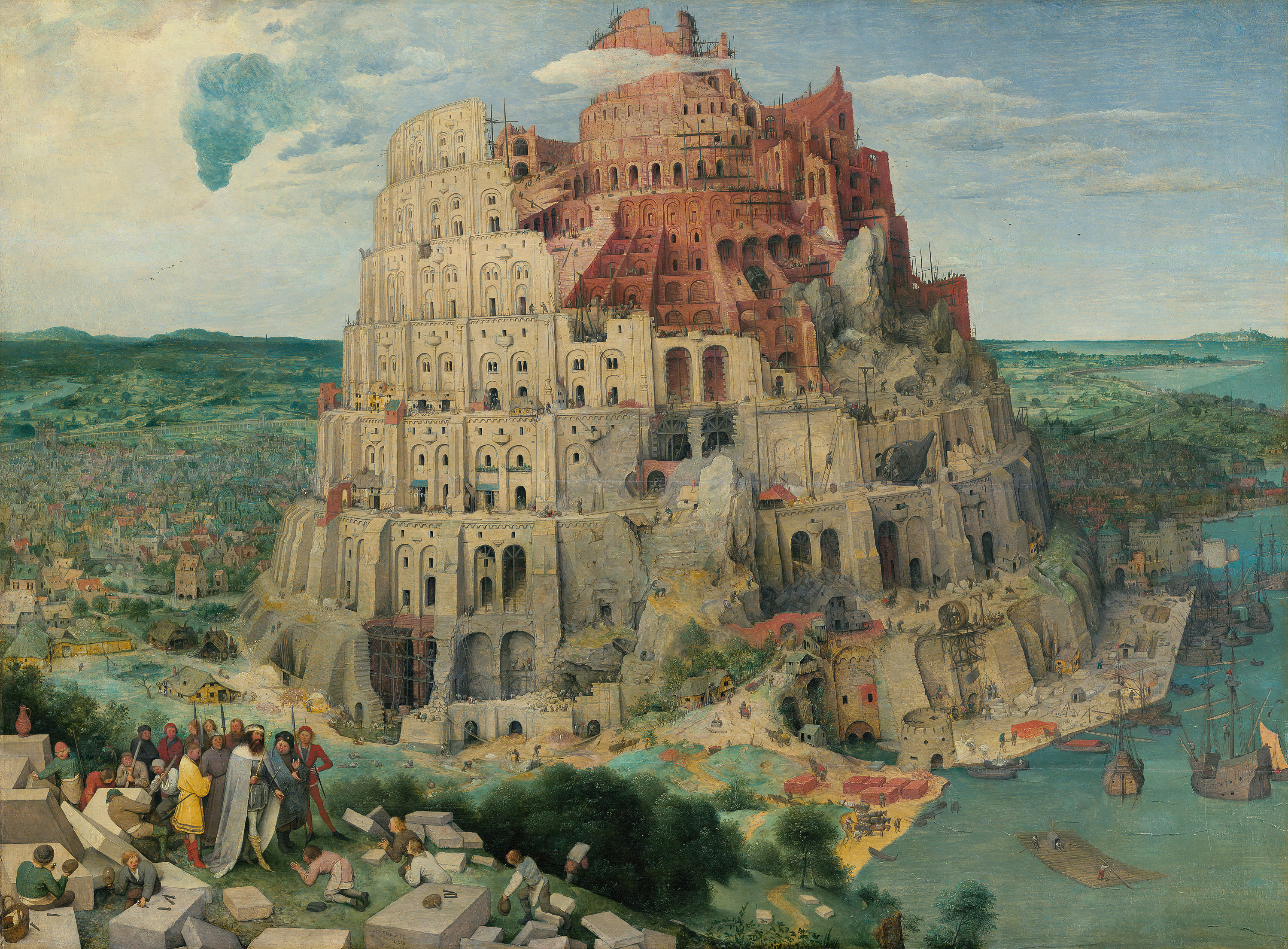
Table of Nations and Tower of Babel
Personal Context
I don’t remember too many reflections on the table of nations or the tower of Babel stories … but I vaguely recall someone mentioning how we spoke one language until humans ruined it by trying to reach and usurp God’s power. Why do humans always ruin everything? Can you imagine how our lives would have been different if we all spoke one language? Currently, there are supposedly over 7000 different languages and dialects. 7000!!! We wouldn’t have so many misunderstandings, tensions, and/or conflicts. Who knows, maybe we would have been able to accomplish so much if we could just understand each other. It was our fault; in our arrogance, we tried to reach God. But is this what was really written in the Bible? Were the people ‘evil’ for building a tower?
But what about Nimrod? Who was he and was he a good or bad guy? My friend recently asked me this very question to understand whether the warrior was a positive or negative figure within the context of the Bible. I said that it was complicated because it really depended on when the tradition was received, whether it is in the initial reading or within the larger context. Then she asked, how did ancient interpreters read the story of Nimrod? Can we use later interpreters to guide the way we should read the story? If they mostly thought Nimrod was evil, then did the biblical author intend Nimrod to be portrayed as a wicked warrior. Again, it is not a simple answer – whose perspective and within what context? The immediate or larger literary context? Interpretations vary and the ways in which we read the text are determined by so many factors. This is something we will be discussing in some detail below.
Ancient Context
Like previous chapters, Genesis 10-11 has been attributed to two sources, the Priestly and Yahwist sources. Therefore within the two sources, distinct intent and theology can be seen in the way they present their history via the genealogy. Yes, genealogy again. While the list of the ancestors and their children can be very, very dry, the table of nations reflects a larger world than we would expect from an ancient biblical author. So just from a curious perspective, it is interesting to know how broad their knowledge of the ancient world was. Yet aside from this factual tidbit, we get an insight into what they considered to be important – details that we may overlook but can be essential in their worldview. Also, within the genealogy, they share stories, i.e. Nimrod and the Tower of Babel, that provides an early view of history which points the direction to the birth of their patriarch, Abram, the ancestor of the Israelites.
Table of Nations
The table of nations is different than other genealogical lists. Whereas other genealogical lists of the antediluvian ancestors are impossible to confirm, the table of nations reflect a broad knowledge of the political geography of the ancient Near East. This is not to say that the table of nations is “historically problematic” because of the “archaeological, anthropological, and philological” discrepancies; yet the ancient author was aware of a larger world beyond Israel and its immediate neighbors.1
Since I am not a geography specialist, though in a brief, very brief stint, I was a high school teacher in Geography, I have depended on other scholarly breakdown of some of the possible 70 nations that are mentioned:2
- Yawan – Ionia (western Turkey)
- Madai – Medes (NW Iran)
- Ashkenaz – Scythians (Siberia to Ukraine)
- Elishah – Cypriots
- Tarshish – Tartessos (southern Spain)
- Kittim – also Cypriots
- Rodanim – Island of Rhodes
- Kush – Nubia (Ethiopia)
- Mizraim – Egypt
- Put – Libya
- Canaan – Palestine
- Havilah – southern Arabia
- Dedan – NW Arabia
- Sheba – Yemen
- Seba – east Africa
- Elam – NW Iran
- Asshur – Assyria
- Arpachshad – Chaldea – southern Mesopotamia
- Lud – Lydia in western Asia Minor
- Aram – Syria
- Eber – “Hebrews”
- Peleg – ???
- Joktan – southern Arabia
- Uz – Edom

This is just a sampling of their knowledge of the geography. It is quite vast from the north as far as Siberia, west as far as Spain, south as far as Arabia/Ethiopia, and east as far as Iran. How did they get this geographical knowledge? Probably from the established trades routes in the ancient Near East; they were not completely cut off from the larger world.
Theology/Worldview of the Sources
Gen 10:1-7
These are the generations of Shem, Ham, and Japheth, the sons of Noah: sons were born to them after the Flood. The descendants of Japheth: Gomer, Magog, Madai, Javan, Tubal, Meshech, and Tiras. The descendants of Gomer: Ashkenaz, Riphath, and Togarmah. The descendants of Javan: Elishah and Tarshish, the Kittim and the Rodanim. From these the maritime nations branched out. [These are the descendants of Japheth] by their lands—each with its language—their clans and their nations. The descendants of Ham: Kush, Egypt, Put, and Canaan. The descendants of Kush: Seba, Havilah, Sabtah, Raamah, and Sabteca. The descendants of Raamah: Sheba and Dedan.
10:20 These are the descendants of Ham, according to their clans and languages, by their lands and nations.
10:22-23
The descendants of Shem: Elam, Asshur, Arpachshad, Lud, and Aram. The descendants of Aram: Uz, Hul, Gether, and Mash.
10:31-32
These are the descendants of Shem according to their clans and languages, by their lands, according to their nations. These are the groupings of Noah’s descendants, according to their generations, by their nations; and from these the nations branched out over the earth after the Flood.
Shem to Abram Genealogy (Genesis 11:10-32)
10:8-19
Kush begot Nimrod, who was the first to be a mighty man on the earth. He was a mighty hunter before YHWH; hence the saying, “Like Nimrod a mighty hunter before YHWH.” The beginning of his kingdom was Babylon, Erech, Akkad, and Calneh in the land of Shinar. From that land he went out to Asshur and built Nineveh, Rehoboth-ir, Calah, and Resen between Nineveh and Calah, that is the great city. And Egypt begot the Ludim, the Anamim, the Lehabim, the Naphtuhim, the Pathrusim, the Casluhim, and the Caphtorim, whence the Philistines came forth. Canaan begot Sidon, his first-born, and Heth; and the Jebusites, the Amorites, the Girgashites, the Hivites, the Arkites, the Sinites, the Arvadites, the Zemarites, and the Hamathites. Afterward the clans of the Canaanites spread out. (The Canaanite territory extended from Sidon as far as Gerar, near Gaza, and as far as Sodom, Gomorrah, Admah, and Zeboiim, near Lasha.)
10:21 Sons were also born to Shem, ancestor of all the descendants of Eber and older brother of Japheth.
10:24 Arpachshad begot Shelah, and Shelah begot Eber (editorial insert).
10:25-30
Two sons were born to Eber: the name of the first was Peleg, for in his days the earth was divided; and the name of his brother was Joktan. Joktan begot Almodad, Sheleph, Hazarmaveth, Jerah, Hadoram, Uzal, Diklah, Obal, Abimael, Sheba, Ophir, Havilah, and Jobab; all these were the descendants of Joktan. Their settlements extended from Mesha as far as Sephar, the hill country to the east.
Tower of Babel Story (Genesis 11:1-9)
Priestly
Aside from the possible geopolitical contributions to our understanding of the region, the question is, what is the function of the table? To what end does the Priestly author include the table? In the Priestly account of the early history, Noah is portrayed as the second Adam from whom all humanity descend. When they exit the ark, God commands Noah and his children to “be fruitful and multiply and fill the earth” (Genesis 9:1). The table of nations is the fulfillment of this command, the one in which Noah’s descendants come to inhabit the earth. Hence the P author closes with this observation:
These are the groupings of Noah’s descendants, according to their generations, by their nations; and from these the nations branched out over the earth after the Flood. (Genesis 10:32)
Noah was more effective than Adam in populating the earth.
But why is populating earth such a central concern for the Priestly author? I mean, in Mesopotamia, overpopulation is a major concern of Enlil, a major deity of wind, air, earth, and storms in the Mesopotamian pantheon. This is the reason why Enlil sends the flood so he can wipe out humanity in order to get some quiet in the Atrahasis Epic. How can two ancient authors have such a very different perspective on the question of the population, whether under or over? One needs to understand the cultural context of the author. The Mesopotamian author of the Atrahasis Epic was probably writing from the city of Babylon, an urban center teeming with people while the Priestly author was concerned about the rural, scattered populace in Yehud, the Syro-Palestinian province of neo-Babylonian empire, the home of the returning Judeans.
The obsession with the need to populate the earth continues to be a focal point for Abram, who is commanded to multiply and take possession of the Promised Land. From the Priestly view, it is imperative to increase in numbers so that the Israelites are able to settle into a land that may have been too big. It reflects the reality of the Second Temple period (and some would argue, to this very day) where there were not enough Judeans to occupy the land that they believed God promised them. Therefore, the command to increase in descendants was not just a divine mandate, but the fulfillment of the divine promise as well as the establishment of the divine order whereby humans represented God on earth. Without enough people, this order would be subverted because humans were expected to have dominion, or govern the earth, reflecting the very power structure in which God had dominion over earth.
Yahwist
As for the Yahwist source, the genealogy introduces territories of neighboring countries, burgeoning civilizations, and the theological underpinnings of human transgression. The Yahwist was not concerned about the vast geopolitical realities that the Priestly source wanted to present. They just wanted to introduce the neighboring countries that provided the backdrop for the descendants of Abraham, the Israelites. It anticipates the covenant with Abraham, the promise of the land from Egypt to the Euphrates River (Genesis 15). At the same time, the table of nations is the means by which the Yahwist elaborates on the birth of powerful civilizations in the ancient Near East. It is not just about populating earth as in the Priestly account, but the urban development that comes with advanced cultures. Consequently, the Yahwist account includes two stories that speak to the rise of civilizations, Nimrod and the Tower of Babel.
Nimrod
The story of Nimrod is a simple insert that provides a good exercise as to how interpretation changes based on the literary context. The insert in of itself has a favorable view of the warrior:
Kush begot Nimrod, who was the first to be a mighty man on the earth. He was a mighty hunter before YHWH; hence the saying, “Like Nimrod a mighty hunter before YHWH.” The beginning of his kingdom was Babylon, Erech, Akkad, and Calneh in the land of Shinar. From that land he went out to Asshur and built Nineveh, Rehoboth-ir, Calah, and Resen between Nineveh and Calah, that is the great city (Genesis 10:8-12)
Nimrod is attributed with building the great cities in Mesopotamia, including southern (Babylonia) and northern (Assyrian) cities. If this information was all we had, then Nimrod is a formidable warrior. Even the way Nimrod is presented in the insert, one is inclined to conclude that he was a servant of YHWH. The expression, “before X,” connotes obeisance or having a good relationship with X. Therefore, when it is said that Nimrod is a “mighty hunter before YHWH,” it is complimentary, not pejorative. Based on his great accomplishments, it wouldn’t be too much to assume that he was a known king in Mesopotamia but unfortunately, it is not clear who Nimrod may have been. Some scholars have conjectured that he may have been the great Sargon of Akkad (2334–2279 BC), the historical and literary king, or Naram-Sin, grandson of Sargon of Akkad who was known for his conquests, but we do not have enough information to link him to any specific historical figure in Mesopotamia.

.jpg)
However, once the Yahwist author juxtaposes the insert on Nimrod next to the Tower of Babel story (Genesis 11:1-9), he is not seen in a favorable light. Nimrod’s kingdom was centered in the land of Shinar, which is where the people build the tower of Babel with its top to the heavens. Since this mobilization is constructed as a threat to the divine power/authority and therefore problematic, Nimrod becomes a menacing figure. This is amplified further in later interpretations where Nimrod and the Tower of Babel are combined as one event in which Nimrod tries to storm the gates of heaven:
Nimrod, the grandson of Ham the son of Noah, an audacious man endowed with innate force, incited the people to insolence and contempt toward God … Lest God seek once again to flood the earth … he would build a tower higher than the water would be able to reach up to, and so seek to avenge the destruction of their ancestors. (Josephus, Jewish Antiquities, I:113-114)
Whereas the insert in of itself does NOT insinuate any participation in the Tower of Babel, Nimrod becomes the primary suspect because of the mention of “the land of Shinar” and juxtaposition to the Babel story.
Tower of Babel (Yahwist)
In the Yahwist source, the development of civilizations and the consequent urbanization undermine the serenity of simple agricultural lifestyle. With Lamech, who is the ancestor of the specialization that comes with development, there was growing violence. And when people come together in the land of Shinar, they began to work together to build a tall tower for two specific reasons:
- Make a name for themselves – fame
- Not be scattered – unity
It seems benign and something one would expect for a group of people to do, especially if they shared a common language. Contrast this with the Priestly genealogy where each people had their own language (Genesis 10:5) before the Tower of Babel:
From these the maritime peoples spread out into their territories by their clans within their nations, each with its own language.
For the Priestly source, language was part of the cultural identity that separated people into nations – a fulfillment of the divine mandate for people to populate the earth. But for the Yahwist source, language, or more specifically differentiated language, was a punishment to scatter the people.
However, YHWH interprets their intent to build a tower as a threat. Just as YHWH kicks Adam and Eve out of the Garden of Eden, because they might take from the fruit of life, and sends the flood to all of creation because the sons of God married the daughters of humans, here too, God thwarts their work. God confuses their language so they are unable to understand each other and was therefore forced to scatter. Consequently, they were unable to finish building the tower.3

.jpg)
So what did they do wrong exactly? One can argue that Adam and Eve disobeyed and therefore was banished from the Garden. But it was not their disobedience but YHWH’s fear that they might become immortal from taking the fruit of life. In other words, they might become like one of the divine beings. Also, one can see how YHWH was disturbed by the mixing of the divine and human blood that led to the Nephilim which epitomize the wickedness of the people. Therefore the need to send the flood. But then, it is not clear how the divine beings marrying humans is the fault of humans; after all, the divine beings approached the daughters of men.
And here we have people working together in unison to make a name for themselves. Yet YHWH is intent on dispersing the people by causing confusion. So what was the problem? Again, it is unclear because their sin is not apparent. But YHWH looks insecure, afraid that humans may accomplish great feats. This is why later interpreters felt impelled to provide reasons for the dispersal:

[Later, the angel says:] “And they [these builders of the tower] had taken an auger, and sought to pierce the heaven, saying, ‘Let us see whether the heaven is made of clay, or of brass, or of iron.’ When God saw this He did not permit them, but smote them with blindness and confusion of speech.” (3 Baruch 3:7-8)
They were keen to pinpoint the blame on the humans whereas the Yahwist did not have a theological issue with portraying an insecure God, a God who did not want humans to surpass the divine:
“Look, they are one people, and they have all one language, and this is only the beginning of what they will do; nothing that they propose to do will now be impossible for them.” (Genesis 11:6)
YHWH felt threatened by what people were capable of accomplishing, perhaps equaling or even surpassing the power of God. Humans are inquisitive, intelligent, beautiful, and very capable. Therefore, humans are even desired by the sons of god. The strange dynamic within the divine-human order appears to be in a fine balance, where at any point within the Yahwist worldview, it may be toppled. YHWH wants to ensure that the balance is maintained.
While the story paints an uncomfortable depiction of YHWH for the modern audience, it also tries to undermine the Babylonians, whose capital resided in the city of Babylon. According to the Yahwist story, the tower in the land of Shinar was called Babel, which the author based on the biblical Hebrew root, בָּלַל (balal; to mix or to confuse). This twists how the Babylonians understood the meaning of the name of their city. For the Babylonians, Babel was bab-ili (“gate of the gods”), the place in which the temple (Etemenanki – “Temple of the Foundation of Heaven and Earth”) of Marduk, the patron god of Babylon, stood. The Yahwist was not about to praise the Babylonian city in which its citizens took great pride because the Babylonians plundered their temple and deported their people. Rather according to the Yahwist author, it was the site where God scattered all the people. This is the power of a story, the rewriting of a city’s history.
Terah (Genesis 11:10-32 – Priestly)
In the line of Shem, Nahor became the father of Terah. From Terah, we now enter into Israelite history since he is the father of Abram, the ancestor of the Israelites. This Priestly genealogy elaborates on Terah’s family in more detail than any other ancestors. So we need to ask, what does the Priestly author include that would give us insight into what they considered to be important:
- Land of birth (Haran, the father of Terah) – Ur of the Chaldeans
- Names of the wives of Abram (Sarai) and Nahor (Milcah)
- Milcah’s birth parent – Haran
- Sarai’s barren state
- Movement from Ur to Haran with intent to head into the land of Canaan
The Priestly author provides details that are pivotal in how Israel came into the Promised Land. Based on the extra information, we can conclude:
- Importance of mother in determining who is chosen, rather than the order of birth – therefore reference to mothers becomes extremely vital
- Importance of God in guaranteeing fertility – elect mothers (Sarah, Rebekah, and Rachel) are usually barren and therefore God needs to act on behalf of the couple
- Importance of wandering/movement towards the land of Canaan
Insofar as the mothers are important in determining who becomes the chosen descendants of Israel, their fertility is essential. However, somehow, these elect mothers are barren, i.e. Sarai, Rebekah, and Rachel. How is this possible that all these matriarchs are barren? Again, it is the power of the storyteller to accentuate the role of the divine. God needs to act on behalf of these matriarchs to ensure progeny so the promise can be fulfilled. Will they bear sons who in turn will father children that will come to inhabit the Promised Land? Oh my, the suspense is too much, but somehow, God always come through. Therefore, both the patriarchs and the matriarchs are dependent on God; they cannot just bear children like everyone else. They need to be blessed with a child.


Also, the patriarchs and matriarchs are constantly on the move, that is moving towards the Promised Land. What I find interesting is how God selects someone from the land of Ur to possess the land of the Canaanites! Why not select someone in the land of Canaan? However, this movement from Ur to Haran to Canaan demands obedience, the willingness to leave one’s own country for the unknown land and future. That is what makes Terah and Abram great. At the same time, the Priestly source gives more credit to Abram for the journey than Terah. The Priestly author does not clearly explain why Terah decides to leave the Ur of the Chaldeans, but Abram is given a promise and according to some later interpreters, he wanted to break from his ancestors:
Terah left Abram to mind the store while he departed. A woman came with a plateful of flour and asked Abram to offer it to the idols. Abram then took a stick, broke the idols, and put the stick in the largest idol’s hand. When Terah returned, he demanded that Abram explain what he’d done. Abram told his father that the idols fought among themselves and the largest broke the others with the stick. “Why do you make sport of me?” Terah cried, “Do they have any knowledge?” Abram replied, “Listen to what you are saying!” (Rabbi Hiyya, Genesis Rabba 38:13)


Is this how the Israelites came into being or was it a story told to help them define their self-understanding, sort of a foundational myth like the story we have in the US about the puritans? If this is the case and the early representation of Israel is not historical, then what may have been the reason as to why the Priestly author wanted the ancient ancestors to come out of Ur, the heart of Mesopotamia. Many scholars have suggested that the story of the journey from Ur to Canaan reflect the later movement of the Judeans from Babylonia to Yehud in the Second Temple period. Therefore the story of Terah may have been fabricated or perhaps, included in the genealogy of Abram to give them hope. Like you, Terah left Ur of the Chaldeans and his descendants came to possess the land of the Canaanites. In time, you too will grow into a great kingdom, the United Monarchy.
Questions
- What is the distinct difference between the Priestly and Yahwist sources in what and how they share in the table of nations?
- How does the story of Nimrod function within its immediate and larger contexts?
- How does the Yahwist explain the name of Babel? Is it the same as to how the Babylonians understood the name?
- What is the function of mentioning that Sarai was barren?
Personal Reflections
- What do you think about the Yahwist theology behind the Tower of Babel story? Do you find yourself resisting the interpretation – “God is insecure?” Why or why not.
- How does one determine what the ‘right’ interpretation is for a text that changes with the reader and their context/theology/worldview?
- Whose perspective(s) should be included in interpreting a text? In other words, should one read with the authorial intent or the perspective of the other? Think about the name of Babel.
- How does the story of Terah impact the way you understand generational progress? Terah moves his family to Haran and Abram moves his family to the land of Canaan.
Final Observations
Which interpretation/reading should be the definitive understanding of the text? Is Nimrod a heroic figure, ready to do divine bidding? Or is Nimrod an evil warrior, set upon attacking God on top of the tower at Babel which he established? Is Babylon, the city of confusion, where the people were scattered or is Babylon, the gate of the gods, where the people and the gods can meet and is therefore a sacred site? Whose interpretation, whose perspective, whose city, whose story is the right version? Or is there no wrong story but just stories? How does one decide? What are the parameters we establish for ourselves?
I wrote above in the personal context section that a friend asked me about Nimrod, is he a good or evil warrior? I couldn’t give a straightforward answer. It would depend on the cultural and literary contexts of the story and of course the context of the reader. So it is complicated, not because I want to make it complicated but because it is.
- Dave Armstrong, “Table of Nations (Gen 10), Interpretation, & History,” Patheos, November 27, 2021, https://www.patheos.com/blogs/davearmstrong/2021/11/table-of-nations-gen-10-interpretation-history.html ↩︎
- John Day, “The Table of Nations: The Geography of the World in Genesis 10,” TheTorah.com, https://www.thetorah.com/article/the-table-of-nations-the-geography-of-the-world-in-genesis-10 ↩︎
- Peleg (“division”), mentioned in Genesis 10:25, may be referring to this story when the “earth was divided.” ↩︎
Leave a Reply