
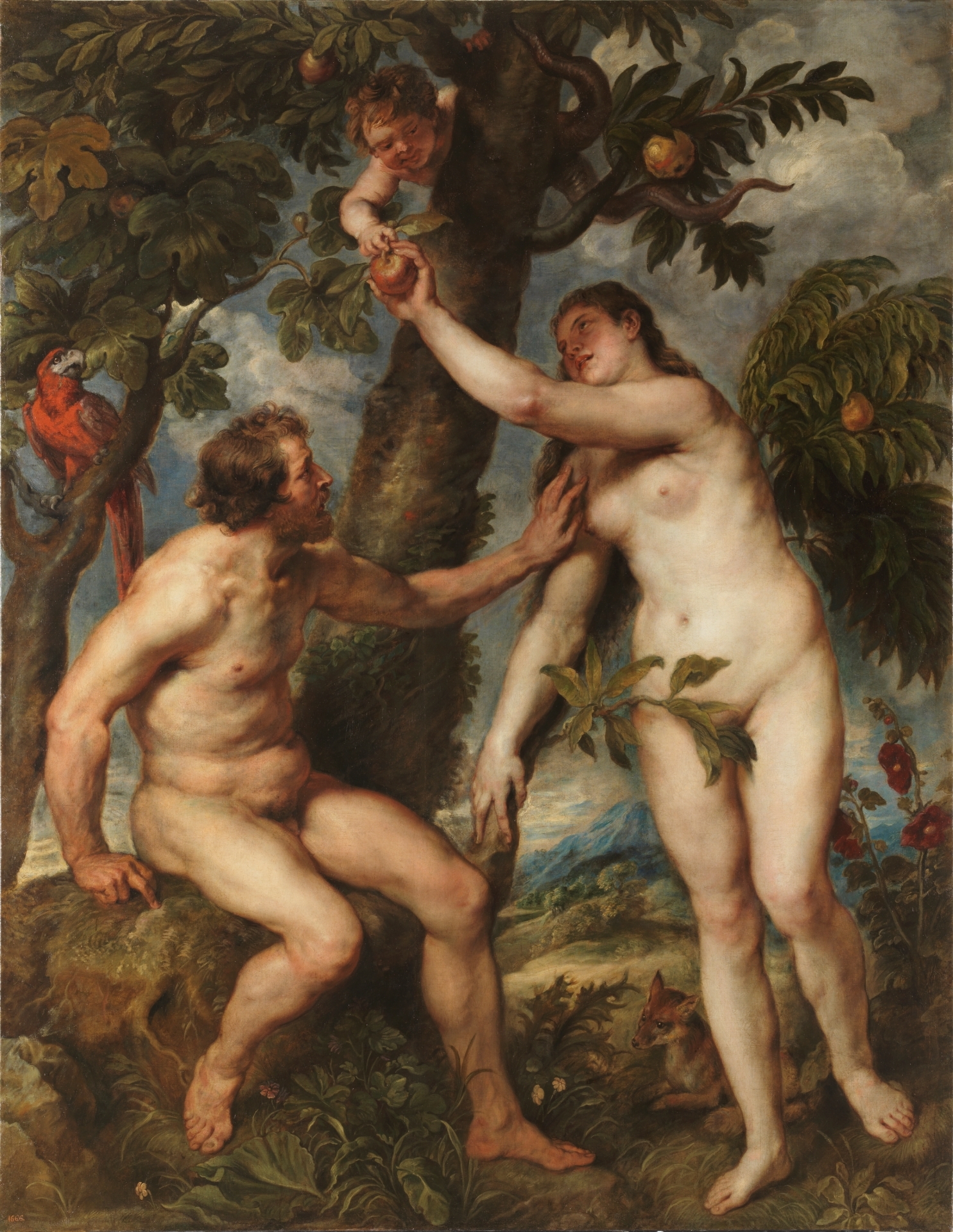
Eve and Adam – The First Couple
Personal Context
If it wasn’t for Eve, all of humanity, or more specifically women, would be in the garden of Eden, blissfully naked, essentially a vegan, and bearing children without pain. And for Christians, if it wasn’t for Eve, we wouldn’t need Christ, i.e. redemption from our original sin. One woman with one pivotal decision basically ruined everything for all of humanity in all times. But then also provided a reason for Christianity. But would do we want a religion in place of paradise? So much power in a choice that would supposedly have made Eve like God. Growing up, I rarely, if ever, heard about Adam except that Eve should have consulted with her husband before making any decision – after all, women should always recognize the authority of men. And the serpent, well, is obviously Satan. She and we should not listen to the evil one because look at what happened to Eve and Adam. Satan doesn’t want humans to enjoy a close relationship with God.


Rather than recognize the intelligence and power of Eve, I was taught to disdain her for the evil she brought into the world. I had to be careful or I, the daughter of Eve, might follow in her footsteps and cause more damage in the world. I needed to obey my parents, more specifically my father, and obey my future husband and of course, if necessary, obey my sons. This is exactly what I learned from a very conservative Bible teacher on Friday nights throughout my teenage years. He did not have any love for Eve and for any woman who dare question a man. I always wondered about his wife, who always covered her head with a handkerchief during Bible studies, trying to follow the New Testament commandment for women to cover their heads. How did she stomach all his teachings or did she just ignore him or did she really believe and heeded him? I never got a chance to ask. But then what precedence would I set by talking to the wife and not the husband? And this is all because of poor Eve.
Given the pivotal role that Eve possessed in Christian imagination, thought, and tradition, it is interesting that she actually is quite insignificant in the Hebrew Bible. Aside from the opening chapters of Genesis, Eve is never mentioned again. Yet she and the serpent (i.e. SATAN) become very important characters later in Jewish and Christian circles. What happened and how did this happen? Given the short space I have to discuss the story, I will not explore the history of interpretations but we will try to touch on the seeds that may have led to later interpretations.

Joke – not sure about the source but I heard it from Fran Drescher on Somebody Feed Phil
After God created Adam, Adam came to God and said, “You created all the animals and each one has a mate, but I’m alone. Can you create me one also?”
God replied, “Well Adam, I can create a mate for you. It will be the crown of my creation, someone who will serve you, and your every need and desire. The most beautiful and loving creature. She will take care of you always , and give you all the respect that is deserving of you. The only thing is, it will cost you an arm and a leg.”
Adam thought for a second and said, “What do you got for a rib?”
Ancient Context
Authorship
When we get to Genesis 2:4b, there is a not-so-subtle shift in the language, creative order, and theology that stands out distinctly from Genesis 1:1-2:4a. This has led many scholars to suggest a different authorship for the story in Genesis 2:4b-3:24, namely attributing it to the Y(J)ahwist source (J), which runs mostly throughout the books of Genesis and Exodus. Here are some of the differences:
Vocabulary
- Name of God is “God, YHWH” (יְהוָה אֱלֹהִים) as opposed to just God (אֱלֹהִים).
- God “molds” like a potter (יָצַר) as opposed to “create” (בָּרָא)
- Words for plant life and animals distinct from words for vegetation and lists of beasts
Order of Creation
- Creation of ‘adam before plants as opposed to vegetation before humanity
- Creation of ‘adam before animals as opposed to animals before humanity
Theology
- Anthropomorphism of God who forms ‘adam, breathes into his nostrils, and walks in the Garden of Eden as opposed to speaking forth creation.
- Intimacy of God who is concerned about ‘adam’s loneliness and nakedness as opposed to just creating and resting
Because of the differences between the stories present in Genesis 1, one can understand why scholars would attribute the story of Adam and Eve to a different author. However, it was not only here but in other places, especially in the duplicate versions of the flood narrative (Genesis 6-9) that led to the theory of multiple authorship/sources within the book of Genesis. Based on the language, themes, and worldview, the Yahwist has a clear theology which shows up in Genesis 2-3:
- Close relationship between God and soil
- Distinct boundary between God and humans
- Progressive corruption of humanity
The process by which scholars have constructed the Yahwist’s theology may feel circular and it is. We come into the theory by inductive reasoning (specific observations to generalized conclusions) and then prove it by deductive reasoning (generalized to specific). In other words, we argue that there is a Yahwist based on reasons I have listed above and then prove that there is a Yahwist source because of the same reasons. There are other theories, story cycles or redaction history, but none of these theories do a better job of explaining the distinction. So until we have a better model, it is the one that is most informative. And therefore, the one I will be relying on as we discuss Genesis 2-3.

So who is the Yahwist and what do we know beyond their worldview? Many scholars date the Yahwist source to the United Monarchy under King David and Solomon (1000-922 BCE), the supposed golden era in Israel’s history. Why is this date important? Because these scholars explain that a scribe within the royal court wrote about the origins of Israel to give legitimacy to the Davidic house. However, within some academic trends, scholars have started questioning the very idea of the United Monarchy or even a Davidic dynasty. As a result, more and more scholars are dating the source later, as late as the post-exilic period (6th-5th century BCE). I personally don’t fall into either of these camps since it is difficult, if not impossible to date the Yahwist source based on what we have. There is nothing definitive, i.e. historical reference or cultural background information that would betray a specific point in history. Consequently, I prefer not to date the Yahwist; nevertheless, it is a distinct source and therefore reflects a different theology.
If we don’t know when they wrote, we are also not clear as to who the Yahwist actually was. So why is it important to acknowledge a different authorship for this story? First, it is acknowledging the shift in the narrative. It is naming the change so it is allowing the text to speak rather than forcing our theology on the text. Just because we believe that the Bible was written by Moses, inspired by God, does not mean that the text attests to such an authorship. Second, the distinct authorship of Genesis 2 allows us to appreciate the different perspectives on God, humanity, Israel, and the relationships amongst them. The Yahwist presented an image of a deity that is more intimate with humanity, more concerned about the well-being of the people. It is not so much a contradiction but a different perspective that contrasts with the first creation narrative, attributed to the Priestly source. Third, and this is integrally connected to the second reason, the early Judeans and Jews who followed were not overly concerned about preserving one view but the multiplicity of voices. It shows a respect for diversity in how people experienced God.
Exegesis of Story
In Genesis 1, we encountered a macro view of creation in which God called forth the elements that make up the earth and the heavens. Then there is a shift to a period when creation only consisted of the earth and the heavens and nothing that inhabited was created (2:4b). It was a time when plant life had not yet sprung up from the ground because God needed someone or something to tend it. Therefore, God first molds the man (ha’adam; הָאָדָם) from the ground (הָאֲדָמָה). The language is distinct from Genesis 1:28, where ha‘adam (“humanity”) is expected to subdue (כִבְשֻׁהָ) the earth (הָאָרֶץ) and to have dominion over the creatures. Here, the man was expected to work it, to care for the ground from where he came. Only after God molds the man does God then plant a garden and let vegetation sprout. In other words, the man was created for the garden and not the other way around. So it was the man’s duty, or their very meaning, to work the ground and to protect it (לְעָבְדָהּ וּלְשָׁמְרָהּ).
Garden of Eden
The description of the paradisiacal Eden is a mixture of real and surreal. The references to Tigris and Euphrates rivers are names of actual rivers in Mesopotamia (“land between the rivers”) but the other references to Pishon and Gihon cannot be pinpointed. There is a possibility that their locations (name/place) may have been lost but it was more likely that the author wanted to provide a surreal setting to the Garden of Eden where there were precious stones, gold, bdellium, and onyx. While we have very few parallels to the Garden of Eden story in ancient Near East myths, there may have been popular oral stories that have yet to be discovered. The Adam and Eve cylinder seal, dated to the 22nd century BCE, might reflect a story of a man, woman, tree, and a serpent. Without a larger context, it is difficult to assess where there may be parallels but then, it may be just a random find that has nothing to do with the myth. Nevertheless, the listener or the reader of the story may ask, “Is this garden real? Can people locate it and find the tree of life, if they can penetrate the cherubim?” The juxtaposition between the real and the fantastic prods the listener/reader to reflect more deeply on the story, the way in which surrealism does currently for our contemporary audience.


As soon as God places the man in the garden, God commands him to eat from any tree but not the tree of knowledge of good and evil. This is God’s first direct communication and if we know anything about brilliant storytelling is that God almost seems to set the man up to fail. Why else would God put a tree and tell the man that he was not supposed to eat from it? The story would have been very short and quite dull if God did not put the tree of knowledge of good and evil in the Garden of Eden. There would be no suspense. So from a literary perspective, one is prodded to ask the question, how will the commandment be broken? The listener/reader is now hooked to the story.
God realizes that the man is alone and decides to find a “helper suitable for him” (עֵזֶר כְּנֶגְדּוֹ). Much has been written about the exact meaning of this clause because of the larger implication of the role of the woman. Without reading too much into the story and what it might mean for all of humanity, I will keep it simple. “Helper” here does not indicate a power dynamic, one in which the helper is like an assistant; rather “helper” which is sometimes used to refer to God points to an entity who is able to help in ways a person or group is not able to fulfill. Therefore, a helper is one who can assist the man as his complement or his opposite so best translated as “his counterpart.”
In an effort to find the man’s counterpart, God individually molds the animals (third element in the order of this creation story). The animals were not created before the man in this creation narrative because the animals were created to find a helper for the man. And it is the man who then names, i.e. gives identity to the animals, but none of them were right for the man which is the reason why God then creates woman from the man’s side (or popularly translated as ‘ribs’).

Yebamoth 63a states that Adam had intercourse with the animals:
And Rabbi Elazar said: What is the meaning of that which is written: “This is now bone of my bones and flesh of my flesh” (Genesis 2:23)? This teaches that Adam had intercourse with each animal and beast in his search for his mate, and his mind was not at ease, in accordance with the verse: “And for Adam, there was not found a helpmate for him” (Genesis 2:20), until he had intercourse with Eve.
א”ר אלעזר מאי דכתיב (בראשית ב, כג) זאת הפעם עצם מעצמי ובשר מבשרי מלמד שבא אדם על כל בהמה וחיה ולא נתקררה דעתו עד שבא על חוה
Since man and woman come from the man, some early rabbis have proposed that the man was actually a double, i.e. male and female in one body. Here is Bereshit Rabbah 8:1:
(1) Said R. Yirmiyah ben Elazar: In the hour when the Holy One created the first adam (human), God created it [as] an androginos, as it is said, “male and female God created them”.
Said Rabbi Shmuel bar Nachman: In the hour when the Holy One created the first adam (human), God created it with a double face [one on each side], and split the adam [along the middle] and made two backs, one back here and one back there, as it is said, “Before and behind You formed me” (Psalm 139:5).
They objected to him: But it says, “God took one of its ribs (tzelah)!” (Gen. 2:21)! He said to them: [Do not translate tzelah as its rib but as] one of its sides, just as you would say, “And for the side (tzelah) of the Tabernacle” (Ex. 26:20).
This is not new to the rabbis but a concept of humanity that was found in the ancient Near East and Greek mythology. Though not fully double bodied, Marduk was described as a deity with 4 eyes and ears to represent his omniscience. And later in Greek thought, according to Plato, Aristophanes shared a myth about the three types of early humans, male, female, and hermaphrodite. The early people had 4 arms, 4 legs, and a head with 2 faces. Zeus split and separated them which is the reason why people seek their partners for wholeness, explaining opposite and same sex attraction.

What I find interesting in the Yahwist’s understanding of the creation of man and woman and their coupling is the interdependent nature of their relationship. In a polygynous society, where most of the biblical characters, the patriarchs and kings, took more than multiple wives/maidservants, the idea that one woman complemented a man does not follow the cultural trend in Israel:
“This is now bone of my bones
and flesh of my flesh;
she shall be called ‘woman,’
for she was taken out of man.”That is why a man leaves his father and mother and is united to his wife, and they become one flesh (Genesis 2:23-24)
Within the Yahwist worldview, the ideal garden was one in which the man and woman worked together as a unit.
Everything seems to be moving according to plan; nothing seems amiss except the author comments on their lack of shame. In ancient Israel, nakedness was the ultimate means by which people were shamed. It is the way in which God punished the Israelites for their disobedience, to be naked before their enemies (Isaiah 20:2-4). So when the man and woman were not ashamed of their nakedness, it demonstrates the trust and lack of judgment between them. There was no need to be vulnerable because in their naked selves, they were completely open to each other. It was a sign of their strong bond.
Yet their bond was short-lived; the woman and the man disobey God, therefore changing the dynamic of all the relationships. So what happened? The serpent, not a snake initially as we understand the creature because of the curse it later receives in the story, entices the woman to disobey God. Now, the snake in the ancient world was known for its wisdom, rebirth, and trickery/deception. So what unfolds in the story is almost a typecast. One did not expect the snake to be anything but deceptive. Nevertheless, nothing in the text or within the Hebrew Bible do we get any association with the pre-curse serpent as Satan. In fact, the very concept of satan (“adversary”) is a very late development in Israel. It is not clear how the serpent came to be identified as Satan in later Jewish and Christian traditions, but the story of the serpent in the Yahwist creation narrative may have been conflated with brief mention of the sea serpent, Leviathan (Job 41, Psalms 74:14, Isaiah 27:1) in the Bible. The sea serpent like Tiamat were associated with chaos in the ancient world.

While we have not found any ancient myths that parallel the story of Adam and Eve, what the serpent does has a familiar ring. In the Epic of Gilgamesh, a snake steals a plant which contained the secret to everlasting life while Gilgamesh, the hero who seeks immortality in the story, was bathing. This explained how snakes would shed their skin, symbolizing the renewal of life. Here too, the snake is responsible for Gilgamesh from gaining everlasting life (tree of life) just as the biblical serpent prevents Adam and Eve from staying in the Garden of Eden and taking advantage of the tree of life.
A number of scholars and pastors have written about the artistry of the serpent’s questioning the woman. Rather than directly asking the woman about the divine commandment, the serpent distorts it:
“Did God really say, ‘You must not eat from any tree in the garden’?” (3:1)
The question begs for a rebuttal and therefore forcing a conversation. So the woman responds:
“We may eat fruit from the trees in the garden, but God did say, ‘You must not eat fruit from the tree that is in the middle of the garden, and you must not touch it, or you will die.’”
If anything, the response reveals the woman’s initial interest in the tree before the serpent even brought it to her attention. First, she knew exactly where the tree was. God never told the man that the tree was in the middle of the garden but she knew. And no, she did not need to consult the man because she was initially part of him when the man received the command and he was there the whole time the serpent questioned her. Second, she needed to add to command to convince herself that the fruit was forbidden by asserting, “and you must not touch it.” How many of us added to a doctor’s orders, parent’s admonition, or a warning to discourage ourselves from disobeying?! I tell myself I shouldn’t eat chips because it is not good for my health, can ruin my figure, can impact my teeth, can’t share with my dogs, etc. I add to the list of possible problems the more I am tempted.
Yet until the serpent started questioning her, the woman did not break the command. She restrained herself. However, the description of what the fruit was able to do for her pushed the woman to eat the fruit. Not only will she not die, but this is the clincher, she will become like God, knowing good and evil. Scholars have different theories about the tree of knowledge of good and evil. Some have suggested that it contained moral knowledge while others have suggested carnal knowledge based on the verb, “to know” sexually (יָדַע).
Most likely, the tree gave the first couple a complete range of experiential knowledge that comes from living life. Good and evil is a merism, where a contrast of extremes refers to a complete concept. Therefore, they will know all that lies between good and evil. The question is, what of the good and evil? Based on other occurrences of the expression, it refers to knowledge that comes from old age, i.e. maturity (Deuteronomy 1:39 and 2 Samuel 14:17-20).

_-_Adam_and_Eve-Paradise_-_Kunsthistorisches_Museum_-_Detail_Tree_of_Knowledge.jpg)
Eve’s rationale to defy the divine command is very intentional and thoughtful. She was fascinated with the fruit which appealed to taste, sight, and wisdom. Yet from the Yahwist perspective, the ‘sin’ was not so much the disobedience but the reason for the disobedience, the woman wanted to become like God, transcending the boundary set between humans and God.
I think it is fascinating that the Yahwist believed that experiential knowledge made humans like God and that this knowledge was what made the man and woman special, what separated humans from animals. Compare this anthropology with Genesis 1 where humans’ authority and dominion, in other words, the power/authority/responsibility given to God’s representatives, distinguishes them from all of creation. And if you were to ask anyone in our contemporary society, what separated humans from God, you may get the answer:
- Omniscience
- Omnipresence
- All-Powerful
- Immortality
- Immutability
- Holiness
- Sovereignty
Here, the Yahwist believed it was knowledge and immortality while the Priestly thought it was their authority. Different perspectives reflecting different cultural context in how they experienced God and other humans.
The woman shared the fruit with her man who was with her. In other words, as the temptation was unfolding, the man was there alongside her but he said nothing. Some have argued that the man was not physically next to the woman but joined her after she ate the fruit; however, the plural form of the serpent’s speech would seem to say otherwise:
“You (plural) will surely not die; for God knows that on the day you (plural) eat from it, your (plural) eyes will open and you (plural) will become like God, knowing good and evil.” (Genesis 3:4)
The bond that made them one flesh also made them act together. But unlike the woman who thoughtfully decided to eat the fruit, the man just ate what was handed to him. This was probably why the Gnostics actually considered Eve to be a heroine. She was the one who brought wisdom, enlightenment to Adam and therefore humanity.
Apocryphon of John (120-180 CE)
Description of Eve:
I am the light which exists in the light, I am the remembrance of the Pronoia—that I might enter into the midst of darkness and the inside of Hades. And I filled my face with the light of the completion of their aeon. And I entered into the midst of their prison, which is the prison of the body. And I said, ‘He who hears, let him get up from the deep sleep.’ And he wept and shed tears. Bitter tears he wiped from himself and he said, ‘Who is it that calls my name, and from where has this hope come to me, while I am in the chains of the prison?’ And I said, ‘I am the Pronoia of the pure light; I am the thinking of the virginal Spirit, who raised you up to the honored place. Arise and remember that it is you who hearkened, and follow your root, which is I, the merciful one, and guard yourself against the angels of poverty and the demons of chaos and all those who ensnare you, and beware of the deep sleep and the enclosure of the inside of Hades.
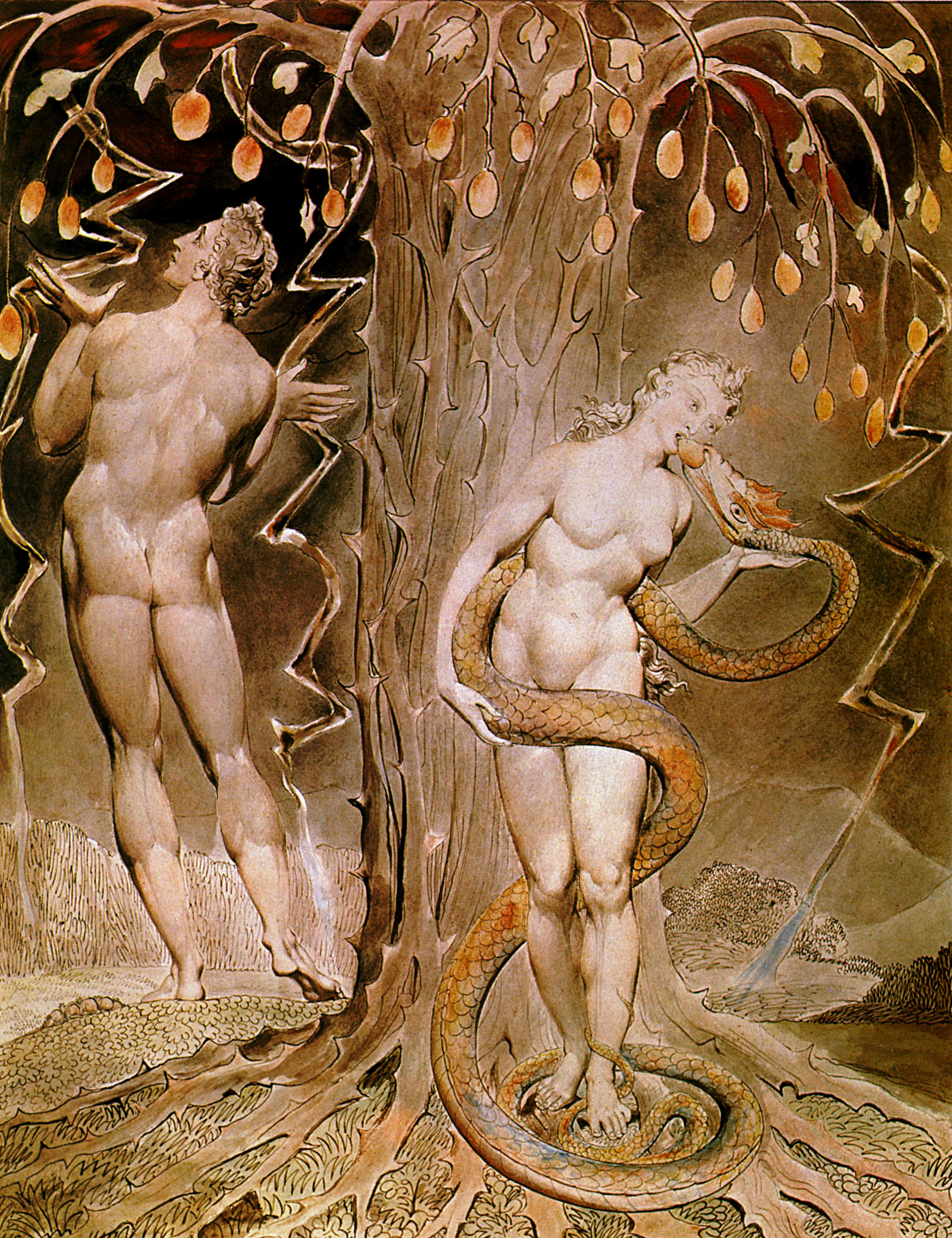
If one followed God’s explanation as to why the man should not have eaten the fruit, both of them should have died immediately. There is no underlying, metaphorical meaning of death in the text. They should have died. It makes one wonder as to whether or not God misinformed the man to prevent them from eating the fruit. Yes, I am implying that God lied to ensure that humans did not become like God. Rather than dying, both of their eyes open and they are able to see their nakedness. It is as if knowledge brought shame or an awareness of their condition, i.e. nakedness, which in the Yahwist worldview was naturally shameful. According to the Yahwist, nakedness is culturally unacceptable so that their ignorance of their nakedness was a form of bliss, a form of ignorance or childlike innocence.
God who is walking in the garden comes into knowledge of their disobedience when God notices the consequences of their action – they were hiding. The intimate nature of all the relationships in the Garden break with the disobedience:
- Between human and God – man and woman hide from God
- Between man and woman – man blames woman
- Between woman and creatures, specifically the serpent – woman blames the serpent
The man and woman may not have died from disobeying the divine commandment but there are consequences to their actions. They must face their punishments:
- Serpent is cursed – will be forced to move on its belly, eat dust, and enmity with humans.
- Woman – pain in childbirth and desire for a man who will rule over her.
- Man – the ground is cursed because of their disobedience so he will have to toil to produce food.
While the serpent and the ground is cursed, the woman and man are not. They are just punished. The wording of the consequences of their action is distinct but is there a significant difference between a curse and a punishment? A curse, one may argue, is longstanding, something that lasts perhaps forever until it is removed whereas a punishment corresponds to a specific action. Therefore, the punishment should only have been directed to Adam and Eve while what happens to the serpent and ground is a permanent condition. Yet the way in which the punishment is meted out to the man and woman, it is intergenerational, something we still struggle to understand. Why do women have pain in childbirth, why do women cling to men when they rule over them, and why do men toil in hardship? There may have been a subtle distinction but it is lost in how the curse and punishment play out in the story. They seem to be similar in function.
And the punishment is descriptive and not prescriptive. The story does not explain how the world should be (prescriptive) as some pastors have sermonized but how the Yahwist have experienced life. Therefore it is a description, an effort to understand how life has become so difficult for humanity. Should a description or more precisely a particular author’s perspective on life become the justification to relegate women to an inferior status? Or should the story be an example of how an ancient person may have thought about inequity and fractured relationships? It happened because we disobeyed but it was not intended by God.
Therefore, one could argue that the story of Adam and Eve is essentially an etiology to explain the reality of life conditions. Why does the serpent slither? Why do women have to bear children in pain? Why would a woman subject herself to patriarchy? Why must man toil for food? It answers some fundamental questions that we still have to today. But there is something deeper, not in the spiritual sense which Christians tend to read into the text. Rather, the Yahwist reflects on the fissure in relationships arising from our choices, choices to transcend our lot in life. Humans need to be human so God can be God. Humans cannot become God just as God cannot become human (story of the Nephilim – Genesis 6:4). Everyone has a role and a place in creation.
And there are casualties in all of this as there are consequences for all of our action and it is the ground. The ground, unlike the serpent, woman, and man, did nothing. It just gave its produce to the couple and yet it is cursed because of the man. Humans were created for the sole purpose of tending and protecting the dry ground but instead, our actions have actually damaged it. The ground in this creation narrative reminds me of Shel Silverstein’s, The Giving Tree.

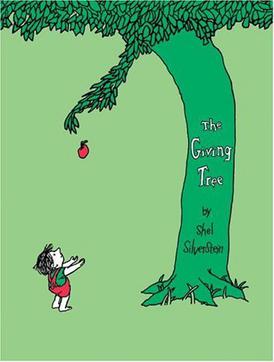
The tree gives and gives and gives but the boy is incapable of loving the tree back only until it is too late. Similarly, the ground is there from the beginning to the end; it is the source of man’s creation and where the man departs from the world. The man comes from the ground; he was created to work the ground; he needs to toil on the giving and then, the ungiving ground; and he will return to the ground.
In the end, tothing is the same. We have the same characters but yet everything has changed. Relationships have been torn asunder and there is shame, fear, and distrust. Consequently, God banishes the man from the Garden for fear that he will eat from the tree of life and live forever. If the first couple gains access to the tree of life, then there will be absolutely nothing that will differentiate humans from the divine. So the Garden is still there, somewhere but the God placed a cherubim so humans would not be able to enter it.
Just because the man and woman disobeys God, God is not necessarily hostile to them. God still clothes them, caring for them the way God care for the man when he was alone. I find this theology very powerful. The Yahwist envisioned an intimate God who walks in the midst of the garden, individually caring for people even though they willingly disobeyed. This is in striking contrast to the Priestly God of chapter 1. Yet the final editor included both stories because they wanted to include different ways in which people experienced God. And depending on their situation in life, sometimes, people experience a distant and sometimes, an intimate God.
Themes
- Disobedience
- Boundary between divine and human
- Punishment vs. Curse
- Yahwist – anthropomorphic and intimate
- Descriptive vs. Prescriptive
Questions
- Who is the Yahwist and why is it important to designate a distinct authorship of Gen 2-3?
- What/who is ‘Adam? How should it be translated, ‘human,’ ‘man,’ or Adam (personal name of a person)?
- Explain what Eve and Adam did wrong.
- Outline the punishment of the serpent, Eve, and Adam.
- Were Adam and Eve mortal or immortal in the Garden of Eden? Explain.
Personal Reflection
- The Yahwist thought that there was a golden era in which there was no gender disparity and easy toil (as opposed to no toil). How is this different from your vision of an ideal society, vision of heaven (if you believe in heaven/paradise)?
- Before reading the discussion above, what did you think was the reason Adam and Eve were driven out of the garden? How has, if it has, changed your view?
- How did your understanding of the punishment/curse change with this brief study?
- Do you think this story explains the fall of humanity? Explain.
Final Thoughts
Eve is neither a villain as within the Christian circles or the heroine as in Gnostic tradition. Rather she is a vehicle, i.e. character like Adam through whom the Yahwist tries to understand why there is suffering in the world. According to the Yahwist, humans suffer because of choice, the choice to become like gods, wanting to possess knowledge. They wanted more than what was allotted to them which was to toil and protect the ground. For their failure to obey, to stay in their lot in life, the woman blames the serpent and the man blames the woman. But the Yahwist does not seem to blame anyone in particular but their ‘inclination’ (yetzer) which tends to be evil (“evil inclination,” יֵצֶר הַרַע; Genesis 6:5). One can sense a level of compassion towards human fragility because according to the Yahwist, God clothes the man and the woman before driving them out of the Garden of Eden. Maybe, according to the Yahwist, God realizes that we can’t help ourselves.
Leave a Reply