
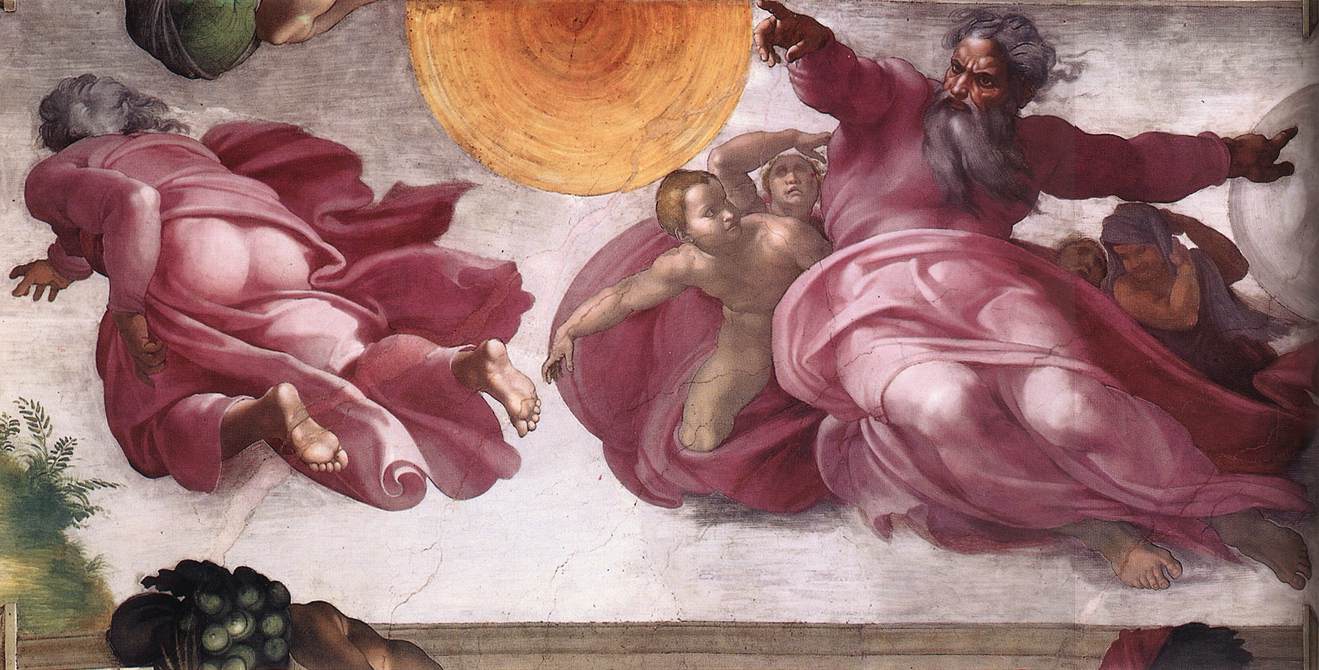
God Orders Creation
Personal Context
How many times have I heard pastors talk about God creating the world out of nothing, demonstrating the omnipotence of our God? God was there from the very beginning, all by himself, when God decided to create ‘adam (אָדָם; Genesis 1:27). They would shout from the pulpit that God created man, not humanity, though everything within the text would point to general reference to humanity, like the plants, lights, sea creatures, birds, and creatures that move on dry ground. God created humanity, male and female, as the pinnacle of all of creation to rule the land. And it was all good.
The goodness of creation was always emphasized because it contrasted with what Eve brought into the world which was in their worldview, original sin. I tried to grapple with what it meant to be ‘good’ because I only knew from my own upbringing that I, as a descendant of Eve, was sinful, only capable of evil. So what does it mean for creation to be good? I wanted and needed to know if there was any goodness in humanity to understand the ways in which the ancient people and perhaps our generation can live into this goodness.
Ancient Context
The creation narrative in the first chapter of Genesis is not unique to Israel; it is similar to its neighbor and oppressor’s creation story, Enuma Elish. Whereas the similarities are quite obvious, it is distinct in how the biblical author envisioned their creator God. The story underscores the power of the divine word in first, making space and second, filling that space with created inhabitants. It is not so much creation out of nothingness but God giving form to the chaos, “the formless void and darkness” (Genesis 1:2) and defining its role within the created world. Only when God has given it shape and determined their responsibilities did God declare the elements good.
The Israelites and Judeans were exiled in stages throughout the Mesopotamian regions. Many of the inhabitants of the northern kingdom, Israel, was deported to the far reaches of Assyria (722 BCE) and the southern kingdom, Judah, was deported to Babylonia (587 BCE).

Therefore, Israelites within the land of Judah, who were under the dominion of the Mesopotamian empires, and those dwelling in Mesopotamia would have been familiar with the Babylonian creation stories like Enuma Elish. Enuma Elish recounted the story of Marduk (and in some later traditions, Ashur) as the god who vanquished the enemy of the gods, Tiamat, the primordial goddess of chaos and the salt sea, and created the world out of her carcass. This story forms the backdrop for the Israelite creation narrative.
Now, I am not implying that the Israelite author borrowed the Babylonian story; rather the author, most likely P (Priestly) was aware of and perhaps changed the story to make it their own. And yes, it is also possible that both the Israelite author and the Babylonian story drew from a common view of creation in the ancient world. But given the glaring similarities, it would not be surprising the extent to which the author overturned popular conceptions of Enuma Elish to give it the Israelite twist to the story. In the end, the Genesis creation story highlighted the worldview and values of the biblical author and their audience.
Key Exegesis
Before discussing the overall structure of the creation story, I want to focus on the first verse from which the theology of ex nihilo is developed. According to the traditional translation based on the King James version, Genesis 1:1 is usually translated as such:
In the beginning God created the heaven and the earth. And the earth was without form, and void; and darkness was upon the face of the deep (“tehom” – cognate of Tiamat). And the Spirit of God moved upon the face of the waters. (KJV – King James Version, Genesis 1:1-2)
Or
In the beginning God created the heavens and the earth. 2 Now the earth was formless and empty, darkness was over the surface of the deep, and the Spirit of God was hovering over the waters. (NIV – New International Version)
However, based on Hebrew grammar, a better translation of the first phrase is:
When God began to create the heavens and the earth, 2 the earth was complete chaos, and darkness covered the face of the deep (tehom – probably cognate to tiamat), while a wind from God swept over the face of the waters. (NRSVUE – New Revised Standard Version Updated Edition)
The King James and the New International versions both assert that in the very beginning of time, God created the heavens and the earth. From absolutely nothing, God created this formless chaos which God began to give shape. However, the New Revised Standard translation, which is actually closer to the Hebrew text, paints a very different picture in which chaotic elements, consisting of earth, darkness, the deep, and wind, existed before creation began to happen. God could have created the chaos in pre-creation (Genesis 1:1) but the author is not interested in or invested in extrapolating a theology of ex nihilo. Rather, the biblical author, most likely within the priestly circle/school, focuses on the way in which God organizes the chaos. This God is concerned with boundaries and order; this is the priestly understanding of creation.
Compare this translation with the opening lines of Enuma Elish:
1. When in the height heaven was not named,
2. And the earth beneath did not yet bear a name,
3. And the primeval Apsû, who begat them,
4. And chaos, Tiamat, the mother of them both,—
5. Their waters were mingled together,
6. And no field was formed, no marsh was to be seen;
7. When of the gods none had been called into being,
8. And none bore a name, and no destinies [were ordained];
9. Then were created the gods in the midst of [heaven],. (Enuma Elish, Tablet 1, lines 1-9)

The beginning of Enuma Elish highlights a time when the heavens and earth were not yet named and destinies were not ordained, and therefore creation had not yet taken place. It was a time when only the chaotic waters, Apsu (“fresh waters”) and Tiamat (“saltwater”) were mingling. So from the Babylonian perspective and probably the ancient Israelite, naming, i.e. giving meaning or role to the element, was a key part of creation, not so much the making of the elements.
The NRSVUE translation of the biblical creation story mirrors the Babylonian creation epic, Enuma Elish. There was formless earth, darkness, deep waters (תְּהוֹם; tehom), and mighty winds before God began to create. What God does is give shape to the chaos to create the world. Giving form by separating the chaotic elements from light, dome, and dry ground and naming all the elements are the very act of creation. It is not what modern theologians have argued in which God creates something out of nothing but rather order and definition of both the contained chaos and the elements that inhabit the ordered space.
| Shaping the Formless Deep | Giving Life to the Space | Tasks |
| Day 1 – Light – Good; Separate light from darkness and named them both | Day 4 – Luminaries – Sun, moon, stars to day and night – Good | Signs for seasons, give light to earth |
| Day 2 – Dome; Separate waters above and below and named dome, sky. | Day 5 – Fish in the waters and birds in sky – Good. | Be fruitful and multiply |
| Day 3 – Gathering the waters – dry ground; God called waters, sea and dry ground, earth – Good. Vegetation with seed in them on earth – Good. | Day 6 – Animals on land and humans – Good | Be fruitful and multiply and have dominion over fish, birds, and land creatures. |
| Day 7 – Finished work on 6th (7th – some traditions) day | Day 7 – God blessed and sanctified the 7th day |
Why is this important? The intent of the creation narrative is not to detail a scientific order of creation or to declare a theological statement of God as the sole, uncreated entity; it is more of a foundational myth reflecting on the Israel’s understanding of meaning in this world and their self-understanding in the midst of imperial rule.
By creating boundaries between light and darkness, between waters above and below, and between the waters below and dry ground where vegetation comes to sprout, God gives shape to the world in a way that provides the canvas in which its inhabitants can dwell. Only when space has been created, does God then create its inhabitants. The stars for the dome, fish for the seas, the birds of the air, creatures for the dry ground, and humans on the dry ground. There is a certain order and rhythm in which God progresses to define the heavens and earth.

And it is not just defining boundaries and filling the space, God then gives a task for each created element. The luminaries are to provide guidance to the seasons, the fish and birds are to multiply and be fruitful, and humans are to be fruitful, multiply, and have dominion over all the creatures. Creation is not just a simple inventory of how God defined the world and created everything in it. It reflects on the very purpose of creation; everything, inanimate and animate, has a purpose so all of creation is essential. One could argue that the ancient text is the very first discourse on the importance of the ecosystem, the interdependence of living organisms and non-living elements. Until creation is given shape, it is not declared as good because God finds delight/pleasure in what has boundaries and then given its purpose. This reflects the value of the Priestly author.
So why does the editor start Israel’s beginnings with the story of creation in which God, not Marduk, speaks creation into order, name it, and give its destiny? A better question would be, how did the Israelites define themselves under the dominant powers, the Assyrians and Babylonians, who had conquered, oppressed, and deported their people to foreign lands? Who are they, the oppressed and forgotten, and more importantly, where was their God?
The answer was simple. Their God who created the world in an orderly structure is the God who chose their ancestor, Abraham, among all the people to receive the divine blessing. The Israelites are the descendants who are to receive the promises made to Abraham. It is not the other nations who also descended from Noah, but our ancestor, Abraham, the nobodies from the land of Ur and settled in the land of Haran.
The creation narrative overturns the ever-dominating worldview in which the Babylonian and its gods are the victors in the political stage of the ancient Near East. It is defying their imperialist overlord’s story in the face of reality. It is NOT your god but OUR God who created the world. This God did not choose your ancestor but our ancestor to receive the blessing. Therefore, this God who entered into a covenantal relationship with us will not abandon us but in time, will restore us, not because we are worthy but because our God will keep the divine promise.
And everything except the sky was considered to be good. Why not sky? It is not clear … perhaps because it is not contained (without clear boundaries except to hold up the waters above and keep the waters below) or perhaps this reflects a scribal mistake. Maybe, and this is hypothetical, is that everything that can produce or is productive is considered good. Light as defined by the sun, moon, and the stars may not produce more stars but their function is to mark the seasons and days. They have a specific role just as vegetation, fish, birds, animals, and humans all have a purpose in creation. Note that “good” (טוב) can refer to a wide range of meanings, beautiful, pleasant, morally good, kind, ethical good, prosperity, etc. The way it is used in our context, it connotes pleasure. God took delight in creation because creation was bountiful and brought forth life.
Because of the goodness, the order, balance, and meaning, of creation and its completion, God was able to rest. The concept and practice of the Sabbath is central to Judaism because it was the defining ritual of the Judeans under the Babylonians and later Persian rule. How does an oppressed people assert their distinction with the pressure to assimilate? We do not work on the Sabbath. But it is not clear as to when or where the concept of the Sabbath originates in Israel, whether it borrowed from its ancient neighbors or was a domestic development. Yet we know, from its attestation in an ostracon found at Mesad Hashavyahu dated to 630 BCE that it was an early practice. Here in the story, the Priestly author attributes the concept of Sabbath to the creation narrative so to the beginning of time. Humanity, the very representatives of God on earth, need to emulate God by resting on the 7th day. It is a sign of completion, a welcome rest from finishing our work.


Side Note
The imperative to humans to have dominion over all animals have been used by Christians to justify the domination (כָּבַשׁ) of earth and subjugation (רָדָה) of all animals. If we are to understand the cultural context of the story, we need to ask ourselves, what kind of world did the Israelites live in and how do the lessons apply in the contemporary context? The Israelites lived in an agricultural society where the land was difficult to farm. Israelite farmers were able to produce food for their families and their overlords by dominating the land including the animals. Since the land was not conducive to agriculture, it was labor intensive, requiring the Israelites to terrace and set up irrigation system to water the fields. So several thousand years later, we need to ask ourselves, do we have to subjugate all the land and animals to produce food? And more importantly, given the degree of environmental damage, can we survive as a people without caring for our earth and all its creatures?
Also, we need to understand the command to “dominate” within the context of the overall narrative. This command parallels what animals are commanded to do except for the command to ‘dominate’ earth and subdue the animals. Humans, male and female, are commanded to be fruitful and multiply but they have the added responsibility to “dominate” and “subdue” because they are created in the image of God. So what does it mean to be created in the image of God?
Usually, the Hebrew word for image (צֶלֶם) refers to the physical representation (statue) of a god or animal. Did the Israelites believe that we looked like God, i.e. face, 2 arms and 2 legs, etc. I have absolutely no idea what God looks like but I think the key here is ‘symbolic representation’. Images of deities are prevalent in Israel like the rest of the ancient Near East. Archaeologists have dug up images of El, Baal, Anat, and Asherah, Canaanite gods and goddesses in the land of Palestine, where they were revered and worshiped in their sacred sites. They possessed features that represented the powers of these deities, i.e. Baal, the god of fertility, rain, and lightning was formed to pose with a lightning bolt and Asherah, the consort of Baal, usually poses with her hands underneath her breasts to accentuate her fertility. To the extent these figurines were clothed, fed, and cared for, they represented the gods on earth because they embodied their powers.




If we are to take these examples in the backdrop for the creation narrative, then humans function as living statues of God on earth. We are to have dominion over the creatures like God has over all of creation. In the Priestly worldview, God had mastery over the people – a relationship in which God was the transcendent lord who the Israelites were expected to emulate. Therefore, humans having dominion mirrored the way in which God had dominion over all of creation. But it is limited since humans did not have power over inanimate elements like the stars, waters, and sky. Consequently, in the ancient world, where power between God and humanity was reflected in a lord-slave rather I-Thou (Martin Buber) relationship, dominion was the way God ruled as Baal ruled with thunder and Asherah milked earth with her breasts.
Themes
- Creation from chaos/deep (tehom)
- Order of and within creation
- Goodness of creation
- Sabbath
Questions to Ponder
- How does our understanding of the creation narrative change with the different translation of the beginning of Genesis?
- What is the purpose of telling the creation narrative?
- What is the worldview and values of the author who wrote the creation narrative?
Personal Reflection
- If we believed that God created us – placed us in our current situation, named us, and given us tasks, how do you think we should show up in the world?
- How does this background help us find our sense of belonging and identity in the face of a difficult situation/opposition/oppression? Where should we find our identity?
- Do you agree with the value that all of creation serves a purpose in the world? Is our current role to be fruitful and multiply? Or is this a Priestly value? How can we re-interpret what it means to be fruitful, multiply, have dominion over earth, and subdue all the animals?
- How is humanity good? Does this speak to your goodness or is humanity completely depraved?
Final Thoughts
The worldview of the author (Priestly) of the creation narrative reflects the ancient cosmology in which the sky, earth, and seas all have the role of housing animate and inanimate elements. Creation is not about the making of the elements but giving a defined space, providing a name, and sharing the purpose in the created world. This is not how we in the modern world would talk about creation – we explore a scientific model of possible hypotheticals of how the world may have come into being. Using the Genesis creation narrative to provide a scientific explanation of the world is missing the point of the story. We get a glimpse into the worldview, into the values, into what they believed was important in creation, in being human, and in being an Israelite under an oppressive regime. The question we need to ask is, in what ways can we use the story to edify us now?
Leave a Reply