
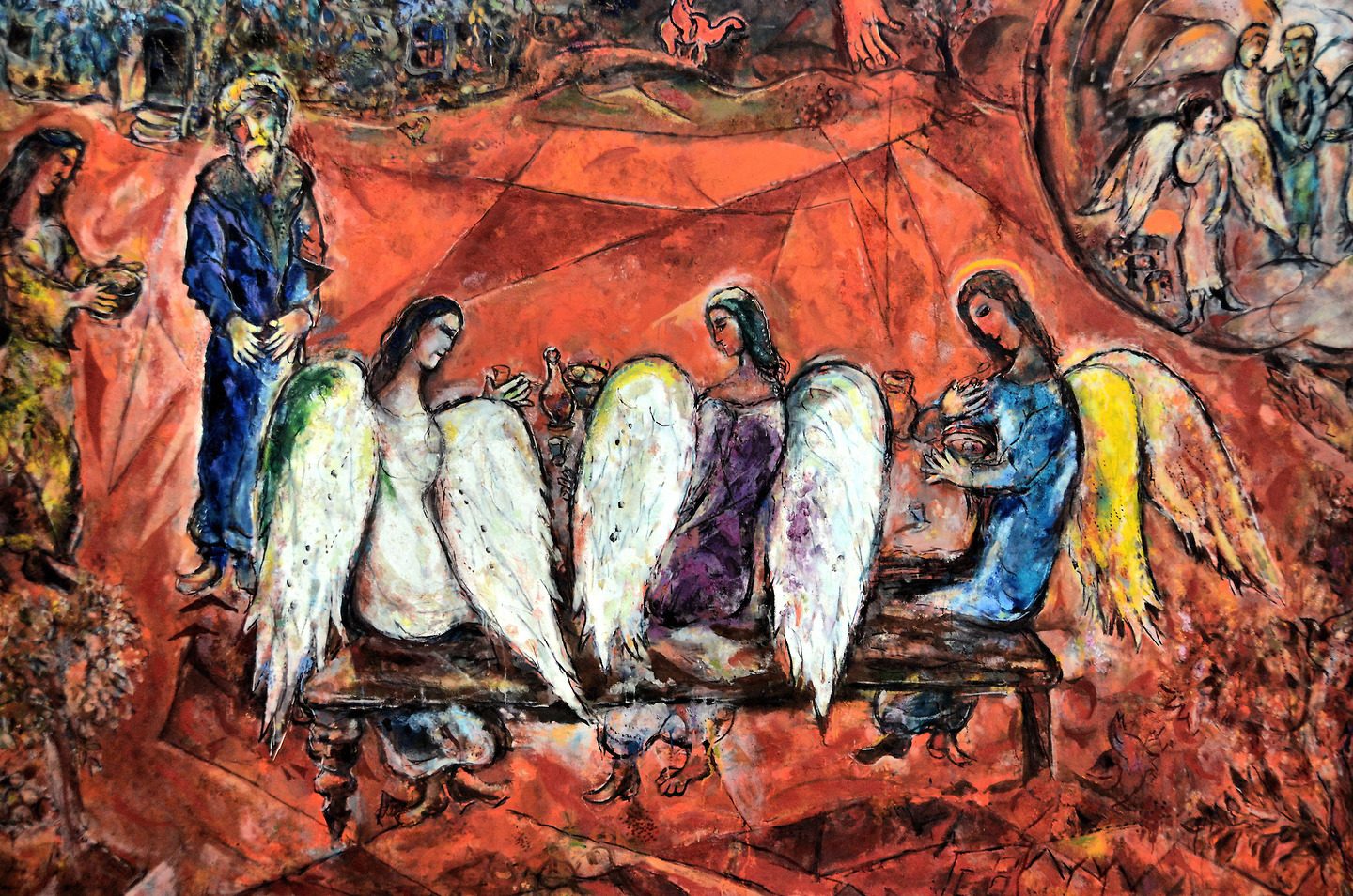
Sodom and Gomorrah (Genesis 18-19)
Personal Context
I can’t remember how many sermons I’ve heard or the conversations I’ve had with people about the Sodom and Gomorrah story. It was THE story for condemning ‘homosexuality’ and explanation as to why we needed to ‘exorcise’ the gay out of people or ban same-sex marriages within the church. Why else would God destroy the cities of Sodom and Gomorrah if not for the evils of the men who wanted to have sex with the two male visitors? It was a clear, black-and-white example of ‘wickedness’ and ‘sin.’
What I find most interesting in these sermons and conversations is how adamant people seem to feel about the obvious nature of the sin, i.e. same-sex relations that speak to modern lifestyles. Obvious. I distinctly remember a heavily-tattooed Bible student at a theologically conservative school lambast the ‘gays’ based on the Sodom and Gomorrah story. I didn’t want to point out Leviticus 19:28 which was obviously a ban against tattoos:
You shall not make any gashes in your flesh for the dead or tattoo any marks upon you: I am the Lord.
Aside from the hypocrisy of the student, his ‘obvious’ interpretation missed the mark. So what was the ‘original’ intent of the story? And if we cannot get to the ‘original’ intent, then how else can we read the story that brings attention to the ancient context that would help us determine the exact nature of the evil in the Sodom and Gomorrah story? If ‘homosexuality’ was not the problem or the sin within the story, then how did it become the paradigmatic story for Christians to revile the LGBTQ? In other words, whose agenda is in the interpretation – God’s, ancient interpreters, or our own?
Over the years, one of the more interesting readings I have heard was from a Jewish perspective in which the interpreter wanted to know why Abraham did not push harder against God. Why didn’t Abraham challenge God to see if even one righteous person could save the cities of Sodom and Gomorrah? It was Abraham’s role as a prophet to stop the destruction of the cities, even for one person or perhaps for all of the ‘wicked’ people, to give them more time to repent. What is our responsibility to stop violence, whether it was warranted or not. Rather than find ammunition to condemn people, the story was highlighting the failure of Abraham to intercede on behalf of the people, righteous or wicked. I guess I prefer the latter interpretation.
Ancient Context
By obsessing on the ‘wickedness’ of Sodom and Gomorrah, interpreters have shifted the intended focus from Abraham to the sin of ‘homosexuality.’ The story of Sodom and Gomorrah was the backdrop to the dialogue between Abraham and God in which Abraham intercedes on behalf of the few righteous people in the wicked cities. Abraham was portrayed as a prophetic voice, challenging the divine decision to punish the people of Sodom and Gomorrah. While sodom has come to denote non-procreative sexual acts, especially anal sex, in the Middle Ages, Sodom and Gomorrah actually signified complete annihilation in ancient Israel. The region of Sodom and Gomorrah near the Dead Sea was a field of salt (pillars) and sulphur. Here the ancient audience would have known about these cities and would have wondered how and why the destruction occurred. One of the explanations was included in the stories about Abraham, how he tried to prevent the massive destruction of the cities where his nephew, Lot, settled. Despite Abraham’s efforts, God had already decided that the cities were too evil to save and the very manifestation of this evil was the sin of inhospitality, not homosexuality.
The Three Visitors
The pericope opens with one of the most perplexing passages in the Hebrew Bible. The LORD appears to Abraham and yet the patriarch encounters three men:
The LORD appeared to Abraham near the great trees of Mamre while he was sitting at the entrance to his tent in the heat of the day. Abraham looked up and saw three men standing nearby. (Genesis 18:1-2)
וַיֵּרָא אֵלָיו יְהוָה, בְּאֵלֹנֵי מַמְרֵא; וְהוּא יֹשֵׁב פֶּתַח-הָאֹהֶל, כְּחֹם הַיּוֹם.
וַיִּשָּׂא עֵינָיו, וַיַּרְא, וְהִנֵּה שְׁלֹשָׁה אֲנָשִׁים, נִצָּבִים עָלָיו;
Who were these three men? Were they angels/messengers of YHWH or was YHWH among the three men!? Should we even read the opening verses as one text or was it perhaps a mishmash of multiple authors/sources and therefore separate traditions which is the reason why there is some ambiguity or confusion? It is not clear which has opened the pandora’s box for later interpreters to share their own readings of the tension.

Interpreters, usually informed by their assumptions, have found creative ways of explaining the tension within the text. According to Rabbi Simon, God appeared separately from the three angels and stayed with Abraham while the angels went ahead to Sodom:
“[The angels] went to Sodom and Abraham remained standing before the Lord” – Rabbi Simon says: “This is a correction of the scribes (tikkun soferim ), for the presence of God was waiting for Abraham.” [Genesis Rabba 49:7]
Rabbi Simon was concerned about the anthropomorphism of God who might have been misinterpreted as one of the three men but this conflicted with Genesis 19:1:
The two angels came to Sodom in the evening, and Lot was sitting in the gateway of Sodom.
What happened to the third angel? IF not YHWH, then did the third angel vanish up to the heavens?! Not too happy in how the passage was corrected, Rashbam (Rabbi Samuel ben Meir [1080-1160], Rashi’s grandson, explained that YHWH was the name of the chief angel:
“YHWH said”—the chief angel (v. 13) … “The men set out from there”—Two of them went to Sodom, as it is written (19.1), “The two angels arrived in Sodom,” while the chief angel remained speaking with Abraham (v. 17). (Rashbam Gen 18:13 – 17)
This resolves the problem of three to two messengers but nowhere else does the name of YHWH refer to a chief angel, whoever that may be. It is a very creative reading but inconsistent with how the name of God appears throughout the Hebrew Bible.
And as expected, the early church fathers saw the Christ figure among the angels, who had the same power as God in the heavens:
Referring to the destruction of the Sodomites, the Scripture says, “Then the LORD rained upon Sodom and upon Gomorrah fire and brimstone from the LORD out of heaven.” For it here points out that the Son, who had also been talking with Abraham, had received power to judge the Sodomites for their wickedness. And this [text following] does declare the same truth: “Thy throne, O God; is for ever and ever; the scepter of Thy kingdom is a right scepter. Thou hast loved righteousness, and hated iniquity: therefore God, Thy God, hath anointed Thee.” For the Spirit designates both [of them] by the name, of God — both Him who is anointed as Son, and Him who does anoint, that is, the Father.” (Irenaeus, Book 3, ch 6)

The various attempts to explain the passage speak to the tension within the story. It is a tension that cannot be easily resolved within the larger context except perhaps to designate different sources within Genesis 18-19. While most scholars attribute the two chapters to the Yahwist source, with minor additions, it does not necessarily resolve the tension. There are no consistent theological justification for dividing the story into multiple sources except for the tension. And that should never be the only reason for separating sources.
This encounter between Abraham and the three special visitors is eye-opening in how it contrasts with what happens in the following narrative. Unlike the way the visitors were treated in Sodom and Gomorrah, Abraham was an exemplary host, whose hospitality embodied the time-honored value of sharing food with strangers in nomadic cultures. He brought them water so they could wash their feet and food consisting of bread, calf, and milk. Abraham was an ideal host and therefore a worthy patriarch. Consequently, the three visitor reiterate the promise of a son through Sarah, a very old woman now, who find herself laughing at the news. But Abraham had proven himself to be a recipient of an intergenerational covenant.

.jpg)
The noble portrayal of Abraham is the pretext for the dialogue that ensues between YHWH and Abraham. Abraham’s hospitality demonstrates to YHWH that God can consult with Abraham about his decision to destroy Sodom and Gomorrah. How can Abraham receive a promise to become a great nation if God cannot share what will happen to Sodom and Gomorrah? How will Abraham show up if/when he and his descendants become a nation? What unfolds is a test like the Aqedah (“binding” of Isaac in chapter 22).
In the following dialogue, Abraham is depicted as a prophet who is willing to challenge God for the sake of the righteous. It pivots on this very question, “Will you sweep away the righteous with the wicked?” Exactly how many righteous people would it take for YHWH to not destroy a city? Abraham stops at 10 and within the ancient context, even the very attempt to challenge God would have been a bold statement about the patriarch. Therefore, in pushing God from 50, 45, 40, 30, 20, and finally 10 depicted a prophet who was willing to put his own life at risk to argue with God. But why this dialogue was included within the story is not clear except to say that it elevated Abraham as a noteworthy prophet on behalf of the people.
But modern Jewish interpreters were not satisfied with Abraham. Should Abraham not have challenged YHWH even more to prevent the destruction of two cities that housed hundreds of people? Yes, Abraham in this story embodies protest theology in contrast to submission theology in the Aqedah (“binding” of Isaac in Genesis 22) but in the face of constant violence, the question is, should we not protest all forms of violence against people, where they are wicked or not? Isn’t there a chance that they may have repented like the city of Nineveh? This is a powerful theological discussion that warrants more attention, much more than our current obsession with the topic of ‘homosexuality.’
So let’s turn to the topic that has become so central in Christian circles. The question is, how bad was the outcry that God sends angels to decimate two cities, Sodom and Gomorrah. And here is where the debate takes center stage. When two angels enter the city and receive hospitality from Lot, men from the city of Sodom come to rape them. Some interpreters argue that the sin of Sodom is homosexuality. So we need to ask ourselves, “Is the whole city, young and old, gay?” And are they trying to make the visitors, the two angelic beings, gay? Should we impose a gay paradigm into a text in an ancient society that did not conceive of the world in such terms? I mean, is there such a concept of a gay lifestyle?
The ancient Israelite culture was patriarchal where marriage was for the production of male heirs to continue the family legacy. So for any man to stray outside of this paradigm was highly problematic – i.e. seed should not be wasted but be planted in a woman to bear heirs. At the same time, it was considered unseemly for a man who in a position of power to take a humiliating submissive role of a woman by being the bottom in a ‘same-gender’ sexual and social position. Therefore, the gay lifestyle was not part of the ancient Israelite mindset and most likely, anyone who resorts to same-gender sexual acts would have not been readily accepted in ancient Israel; it destabilized the social fabric of a patriarchal society.
Nevertheless, the wickedness of Sodom and Gomorrah was not so much ‘homosexual’ acts but how the very threat of forcing men, especially guests, to take the role of women, i.e. subservient roles, was shameful. As I mentioned above, hospitality is essential in the ancient nomadic world of Abraham and the patriarchs; it was what defined the honor of a family/clan/town. Therefore, Abraham and Lot both offered an important service by inviting the visitors and giving them a meal. However, the men of Sodom did not want to provide hospitality but tried to rape these visitors, to shame them by forcing them to become “like women.” By its violent actions, Sodom and Gomorrah exemplified a topsy-turvy world, where the threat against strangers undermined the stability of the community.
The breakdown of the social mores of the nomadic culture, i.e. inhospitality, demonstrated the reason why God had to destroy the cities of Sodom and Gomorrah. The men were trying to shame, to violate their guests. If anything, the text reflect the anti-women, and therefore patriarchal structure that declares, “no men should be treated like women” because women were mere possessions. This probably should have been why there was unspeakable evil, the way in which women were perceived and treated. Lot thought it was acceptable to offer his daughters in place of his guests. What kind of society would allow fathers to treat their daughters like chattel!
Other passages when referring to Sodom and Gomorrah within the Hebrew Bible and New Testament also do not speak of ‘homosexual acts’ but rather injustice. In the book of Ezekiel, the prophet claims:
“‘Now this was the sin of your sister Sodom: She and her daughters were arrogant, overfed and unconcerned; they did not help the poor and needy. They were haughty and did detestable things before me. Therefore I did away with them as you have seen. (Ezekiel 16:49-50)
Isaiah also talks about the sin of Sodom in the context of sins in which disorder and oppression rules:
A man will seize one of his brothers
in his father’s house, and say,
“You have a cloak, you be our leader;
take charge of this heap of ruins!”But in that day he will cry out,
“I have no remedy.
I have no food or clothing in my house;
do not make me the leader of the people.”Jerusalem staggers,
Judah is falling;
their words and deeds are against the Lord,
defying his glorious presence.The look on their faces testifies against them;
they parade their sin like Sodom;
they do not hide it.
Woe to them!
They have brought disaster upon themselves. (Isaiah 3:6-9)
Because of their wickedness, Sodom and Gomorrah is completely destroyed. Based on other references to Sodom and Gomorrah, these cities became the exemplar of complete annihilation, “burning waste of salt and sulphur” (Deuteronomy 29:23; see also, Amos 4:11, Matthew 10:15, Luke 10:12).

One can therefore argue that traditions about Sodom and Gomorrah circulated in ancient Israel as examples of what happened to evil cities. However, the reasons for the divine punishment differed slightly within different circles. Yet they spoke of oppression, injustice, disorder, and inhospitality, the mark of a society that has turned upside down. It was not a comment on ‘homosexuality’ or same-gender sexuality.


Lot and His Daughters
The upheaval in social norms continues in the following section. Lot and his two daughters survive the destruction and find themselves in the mountains. While they could have rejoined Abraham or any of the surrounding towns, they decide to hide in the mountains. As if they are cut off from all of civilization, the daughters plot to procreate through their father, Lot (the last man on earth???). They get their father drunk and each daughter has a son through their father. The sons are Moab (‘from father’) and Ben-Ammi (‘son of my people’), neighboring countries of Israel. It is a derogatory origin story of the Moabites and the Ammonites. They are a people who come from overturned societal mores, i.e. Sodom and Gomorrah, and they survived by having their father birth the incestuous people of Moab and Ammon.
Questions
- What tension is there between Genesis 18:1, 18:2, and 19:1? How would you explain the tension?
- What was the proverbial Sodom and Gomorrah? Was it in reference to the ‘wickedness’ or what happens to wicked cities, i.e. complete annihilation?
- What social institution was important in nomadic cultures? Why do you think?
- In challenging God as to whether the righteous should die with wicked, what was Abraham trying to accomplish? How was he being portrayed?
Personal Reflections
- Did Abraham challenge God for the righteous or for the wicked? Should he have protested for everyone?
- What is the role of a prophet? To speak for God or to speak up for people?
- What is more problematic, focusing on ‘homosexual acts’ or ignoring Lot’s offer to have the men of Sodom and Gomorrah rape his daughters? Why is it so ‘male’ focused?
- How are Lot’s daughters resourceful given their situation? Is it a negative or positive portrayal?
Final Observations
The cultural context as well as the agenda of the reader impacts how they read and hear biblical stories. We find in Abraham, the protest and complicit theologian; we find in the Sodom and Gomorrah story, a commentary against the LGBTQ. These interpretations are just that, interpretations that help modern readers to make sense of their worlds within their traditions. It isn’t wrong but it is reading into the text what is not really there.
If the intent is to get to the original meaning of the text and to apply these meanings to current times, then some of the modern interpreters missed the mark. The story of Abraham is to elevate the patriarch to be worthy of the promise; the story of Sodom and Gomorrah was the proverbial consequence of sin. To what intent did the ancient author include these stories? It is not really clear why Abraham is portrayed as a prophet who speaks on behalf of the few righteous. If the Yahwist was writing from the Davidic court, perhaps it wanted to show that Abraham’s descendants were just kings. As for the Sodom and Gomorrah story, it formed the backdrop for Abraham’s dialogue with God. Since Sodom and Gomorrah were known as cities destroyed by God, i.e. a region of salt and sulphur that had a pillar of salt (Lot’s wife), it was fitting that Abraham discussed the possible merits of cities that were annihilated. Abraham tried but God thought otherwise. Their acts of inhospitality demonstrated the reason for the destruction. And the very wickedness of Sodom and Gomorrah continued with the people of Moab and Ammon.
When I read the story of Sodom and Gomorrah, I sometimes have difficulty silencing the numerous sermons I have heard over the years. Having been a part of the Christian culture that has been keen to denounce the LGBTQ community, I struggle to disengage the ancient story from my own context. Nevertheless, I make a concerted effort to re-read, re-contextualize, and re-frame the stories to better understand the ancient context. This in turn has helped me to see how interpretations can get skewed along the lines of our own agenda. And if our agenda is to marginalize people, then we need to re-evaluate our cultural misgivings and see if this is the agenda we want to perpetuate, especially if it does not align with the ancient interpretations.
Leave a Reply