
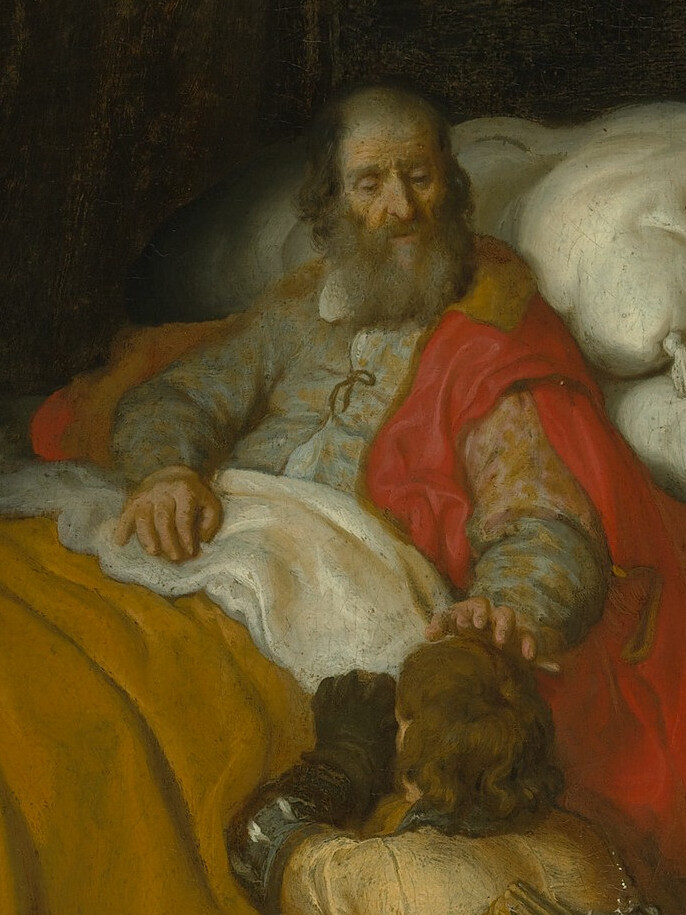
Isaac – Child of the Promise
Personal Context
When we became US citizens, my mother wanted to change our names. She wanted us to choose names from the Bible so we can live into our mission in life. I changed from my multiple Korean names (for immigration purposes) to Samantha (female version of Samuel, my model biblical character). My mother became Sarah and she tried to convince my father to change his to Abraham. In defiance, he never became a US citizen and he never changed his name. It was the same with my oldest brother. He begrudgingly became a US citizen for educational purposes and he refused to change his name for anyone, especially my mother. My mother wanted to change his name to Paul so he could evangelize everyone. She wanted all of us, especially my oldest brother, to make a difference in the world.
Yet when my oldest brother had a child, he decided to name him Isaac. By the time my brother had married, he had converted to Christianity from agnostic Confucianism. According to my brother, Isaac didn’t do much but he received all the blessings. Unlike my mother, he wanted an easy life for his son, a life full of blessings and very little impact in the world, i.e. responsibilities. What made Isaac so special that without much effort, everything was handed to him? While a major patriarch – God of Abraham, Isaac, and Jacob – he was always in the background, sort of a supporting actor but non-memorable one. Isaac would never ever have won an Oscar for main or supporting role.
To better understand Isaac, we will examine a few select passages but focus on chapter 24, where a servant of Abraham goes to seek a wife for Isaac. Isaac himself does not appear until the end of the chapter, where he marries Rebekah, who was brought to him at the age of 40.
Ancient Context
Isaac’s Birth and Childhood
Isaac is special, not because he does anything special but because he was born into special circumstances. He was the descendant promised to Abraham back in Genesis 12 when he left Haran for the promised land. However, Isaac did not materialize immediately and based on the genealogy, Abraham had to wait 25 years as he wandered in the land of Canaan before he was born. Yet all that time, God never specifically told Abraham exactly when he was to have a child through Sarah except the year before, in the 24th year. Imagine leaving your home and your family in a tribal society only with the promise of a land and descendants and never really know when you will even have an heir to the covenant. So Isaac was this long awaited child, whose personality as unremarkable as King David was noteworthy.

Abraham did not know when he would have the promised child; yet he journeyed to the land of Canaan. One has this image of a man who was unswerving in his convictions, after all, Abraham was known as a man of faith. However, we have a different portrayal of a man who wasn’t always certain as to whether or not he should trust God or the covenant promised by God. What benefit would he have if he did not have a child to receive the promise:
But Abram said, “Sovereign Lord, what can you give me since I remain childless and the one who will inherit my estate is Eliezer of Damascus?” And Abram said, “You have given me no children; so a servant in my household will be my heir.” (Genesis 15:2-3)
Yet God assures Abraham that he will have a biological child. But when? God does not share the details with Abraham. This was the reason why Sarah tries to take matters into her own hands. Since her future is at risk, she tells Abraham to sleep with her maidservant, Hagar, who can bear a child for her. He obeys his wife and Hagar becomes pregnant with Ishmael but according to the divine messenger, he is not the promised child. Ishmael receives gifts from Abraham (Genesis 25:5-6) but he was not the child of Sarah through whom the covenant will be made.
The anticipation of Sarah’s child, Isaac, is the literary device that drives the Abraham narratives. Will Sarah have a child? When will Sarah have this child? What will happen to the divine promise if Sarah doesn’t have a child? It’s not only the audience but Abraham and Sarah both doubt whether this will ever happen:
God also said to Abraham, “As for Sarai your wife, you are no longer to call her Sarai; her name will be Sarah. I will bless her and will surely give you a son by her. I will bless her so that she will be the mother of nations; kings of peoples will come from her.” Abraham fell facedown; he laughed and said to himself, “Will a son be born to a man a hundred years old? Will Sarah bear a child at the age of ninety?” And Abraham said to God, “If only Ishmael might live under your blessing!” (Genesis 17:15-18)
Then one of them said, “I will surely return to you about this time next year, and Sarah your wife will have a son.” Now Sarah was listening at the entrance to the tent, which was behind him. Abraham and Sarah were already very old, and Sarah was past the age of childbearing. So Sarah laughed to herself as she thought, “After I am worn out and my lord is old, will I now have this pleasure?” (Genesis 18:10-12)

Both Abraham and Sarah laugh at the prospect of a having a child so late in their lives.
Given all the anticipation, one would expect an extraordinary child, one who would be worthy of the covenant. But the depiction of Isaac is limited; we know very little about his character based on what is included in the Bible. So what information do we have? Isaac, according to his namesake and Sarah’s explanation, is one who brings laughter:
Sarah said, “God has brought me laughter, and everyone who hears about this will laugh with me.” And she added, “Who would have said to Abraham that Sarah would nurse children? Yet I have borne him a son in his old age.” (Genesis 21: 6-7)
Yet the very act of laughter (Qal stem of צָחַק) becomes a source of conflict between Ishmael and Isaac. The same root in the Piel stem has been translated to reflect an ‘intensive’ use of the verb, “mocking,” “playing”, or “making fun of.”
But Sarah saw that the son whom Hagar the Egyptian had borne to Abraham was mocking. (NIV)
But Sarah saw the son of Hagar the Egyptian, whom she had borne to Abraham, playing with her son Isaac. (NRSVUE)
But Sarah saw Ishmael making fun of Isaac. (Ishmael was the son of Abraham by Hagar, Sarah’s Egyptian slave.) (NCV)

It is difficult to say exactly what Ishmael did wrong to warrant banishment. However, based on similar attestations of the word in the Hebrew Bible, multiple meanings can be derived:1
Mocking:
So Lot went out and spoke to his sons-in-law, who had married his daughters, and said, “Up, get out of this place, for YHWH is about to destroy the city.” But he seemed to his sons-in-law as a metzacheq. (Genesis 19:14)
Dancing:
As their spirits rose, they said, “Call Samson here and let him play for us.” Samson was fetched from the prison, and he tzacheq-ed for them. Then they put him between the pillars. (Judges 16:15 – dancing as in entertaining)
Sexual:
She [Potiphar’s wife] called out to the members of her household and said to them, “See, my husband has brought among us a Hebrew to tzacheq with us. He came in to me to lie with me, and I cried out with a loud voice…” (Genesis 39:14)


When Isaac had been there a long time, King Abimelech of the Philistines looked out of a window and saw [Isaac] metzacheq-ing his wife Rebekah. So Abimelech called for Isaac, and said, “So she is your wife! Why then did you say, ‘She is my sister’?”… (Genesis 26:8-9)
This led some ancient interpreters to explain that Ishmael was banished for sexually aggressive behavior. According to R. Akiva:
R. Simon said: R. Akiva would read this term as something negative.
R. Akiva taught: “…Metzacheq means sexual transgression, as it says [in the Joseph story, when Potiphar’s wife addressed her husband]: ‘to tzacheq with me.’
This teaches that Sarah would see Ishmael forcing his way into gardens, grabbing hold of other men’s wives, and raping them.” (Genesis Rabbah 53)
While R. Akiva refer to general sexual violence, if such a connotation was intended, one could argue that Ishmael ‘molested’ Isaac. Without question then, Sarah had the prerogative to send him away. However, would an ancient author wanted to have included an episode in which the child of the promise was sexually molested by another young man? In the case of Joseph, he was accosted by Potiphar’s wife, not molested by her. I doubt an ancient author would have wanted to paint a ‘feminized’ image of the patriarch.
Whatever the intended connotation, note that it was Sarah who tried to protect Isaac by banishing Hagar and Ishmael; Isaac did not say or do anything. One could argue that Isaac was just weaned, probably at the age of 3, so he would not have been able to fend for himself. Yet the passivity is consistent with his characterization throughout the Hebrew Bible.
In the Aqedah (Genesis 22), Isaac is mostly passive. Abraham essentially places the wood on him so he can carry it to the site of the altar. He binds and lays Isaac on the altar. The only voice Isaac has in the whole chapter was his question,
Isaac said to his father Abraham, “Father!” And he said, “Here I am, my son.” He said, “The fire and the wood are here, but where is the lamb for a burnt offering?” (Genesis 22:7-8)
Based on the story, we know that Isaac was old and capable enough to carry wood and needed to be bound for Abraham to slay him. Though he was probably able to resist, it would to safe to say that he did not put up a fight against his father and was placed on the altar.
That is the extent of his literary presence until we get to Genesis 24. Sarah had passed away and Abraham, not Isaac, is seeking a wife for his son. The story is a wonderful take on the woman-at-the-well motif or betrothal type scene that underscores the character of the gender roles between future couples.
Genesis 24 – Betrothal Type Scene
In ancient Israel, it seemed to have been common for men to meet their future wives at the well. Since women and men did not generally interact, there were few spaces where they would encounter the opposite gender. One of those spaces was the well, where women would come to draw water for daily chores and shepherds would draw water for their flocks. Biblical authors used the well as the backdrop to elaborate how main characters met their wives. Through the type scene, they did not just reiterate the motif but actually tweaked their depiction of the encounters to accentuate the key features of the characters.
Here are the 4 use of the betrothal at the well typescene:
- Isaac and Rebekah
- Jacob and Rachel
- Moses and Zipporah
- Jesus and the Samaritan woman – twist on the betrothal typescene
To demonstrate how Isaac is portrayed in Genesis 24, I want to contrast the story with the stories of Jacob and Moses. Since Jesus and the Samaritan woman is unique and overturns the betrothal typescene, I will not include a discussion of this story.
Jacob and Rachel (Genesis 29)
After tricking his father and betraying his brother, Jacob leaves Canaan and heads to Haran, where his uncle resides. As he nears Haran, he finds himself at a well where he asks shepherds about his uncle, Laban, the son of Nahor. They inform him that Rachel, Laban’s daughter is actually coming towards them. Here is what follows:
Now as soon as Jacob saw Rachel the daughter of Laban his mother’s brother, and the sheep of Laban his mother’s brother, Jacob came near and rolled the stone from the well’s mouth and watered the flock of Laban his mother’s brother. Then Jacob kissed Rachel and wept aloud. And Jacob told Rachel that he was her father’s kinsman, and that he was Rebekah’s son, and she ran and told her father. (Genesis 29:10-12)


Jacob is proactive and assertive. He approaches Rachel, removes the stone and waters the flock, and then kisses her. Rachel responds to him because he initiates. While love at first sight, it takes 7 years, plus an additional 7 years, for Jacob to earn his marriage to Rachel because of the trickery of his father-in-law, Laban. Yet Jacob does not deter or change his mind; he is determined to marry Rachel and even though she is unable to have children until later, he is devoted to her. Jacob’s initiation and persistence are characteristic of his character.
Moses and Zipporah (Exodus 2:15-22)
Moses flees from Egypt because the Pharaoh was trying to kill him for having murdered an Egyptian. While on the run, Moses encounters the seven daughters of the priest of Midian but when some shepherds try to drive them away, he comes to their defense:
But some shepherds came and drove them away. Moses got up and came to their defense and watered their flock. (Exodus 2:17)

Before his transformation in Midian, Moses was eager to protect the Israelites; after all, he killed an Egyptian to defend a Hebrew. Consistent with his character, Moses showed up for the seven daughters, one of whom he eventually married. He becomes a reluctant servant while living as a shepherd in the wilderness for 40 years.
Isaac and Rebekah (Genesis 24)
We now come to the story of Isaac and Rebekah. Abraham, in his old age, charges his oldest servant to find a wife for Isaac, his son, among his kinfolk. The oldest servant prays before he situates himself at the well where he approaches Rebekah, who he finds out is the daughter of Bethuel.


Rebekah is the one who pours out a drink for the servant and his camels. Isaac is nowhere – either in Abraham’s decision to find a wife for him or in Aram-Naharaim. He plays no role in finding his wife, Rebekah, who is the assertive partner in the relationship. She leaves her home on the very next day to go to a foreign land to marry a man she has never met:
And they called Rebekah and said to her, “Will you go with this man?” She said, “I will.” So they sent away their sister Rebekah and her nurse along with Abraham’s servant and his men. (Genesis 24:58-59)
Isaac only comes into the picture when Rebekah comes to him in the Negeb. He sees her camels but it is Rebekah who asks Abraham’s servant about Isaac. Isaac seems to have been in the dark about the whole situation until the servant informs him of everything. The only active part that Isaac plays is when he sets Rebekah up in his mother’s tent:
Then Isaac brought her into his mother Sarah’s tent. He took Rebekah, and she became his wife, and he loved her. So Isaac was comforted after his mother’s death. (Genesis 24:67)


Isaac’s love story is actually is father and servant’s doing; even in his old age, he is a passive figure. He marries Rebekah at the age of 40 because his father stepped up for him. Who knows what would have happened if Abraham and his servant did not seek out a wife for Isaac?
This is not the end of Isaac’s story but it is reflective of his character until he dies. He is overshadowed by his father, Abraham, and then his son, Jacob. Because of his passive character, Jacob was able to take advantage of him in his old age. His own son, with the help of the dominant Rebekah, was able to steal Esau’s blessing from him and he was powerless to do anything about it. Despite his ‘weak’ personality, he was blessed because he was the son of the promise:
Isaac planted crops in that land and the same year reaped a hundredfold, because the Lord blessed him. The man became rich, and his wealth continued to grow until he became very wealthy. He had so many flocks and herds and servants that the Philistines envied him. (Genesis 26:12-14)
Wherever he went, whatever he did or did not do, Isaac was blessed by God.
Questions
- How much did Abraham know about his future when he was commanded to leave Haran?
- When did Abraham definitively know that Sarah would have a child?
- How would you describe Isaac to a person who has never read the Bible?
Personal Reflections
- Based on the different characters introduced in the Bible so far, what personality types predominate? How can this inform your ‘theology’ as to who is favored by God?
- What do you have to do to earn God’s promise/covenant?
- If you were to meet Isaac on the road or in a restaurant, would you like him? Why or why not?
Final Observations
My mother wanted all of us to become the “Paul” of the Bible, evangelizing and sacrificing everything for God. My brother had a different idea of what it meant to be God’s servant, do as little as possible for the greatest blessing of all. Very distinct understanding of mission – one life full of suffering but amazing impact for all of Christianity and the other, a quiet life of little impact but abundant blessing for oneself and family. Did either of them choose their journeys or did a life consistent with their character unfold before them?
My mother was a go-getter; she was on a mission to bring everyone to Christ so our home was always bustling with people. My brother is a quiet introvert; he would rather sit in his home cleaning or in the garden, digging out weeds than talk to anyone about Jesus. Very different people yet both very Christian in their own ways. If there was anything I learned from the stories about Isaac is that people live out their purpose according to their personalities. Isaac is not Abraham or Jacob. Isaac is who he is and nevertheless, he is a patriarch who received abundant blessing because he was the son of the promise.
- See Lisbeth S. Fried, Does Ishmael Molest Isaac, for a detailed discussion of the meaning of the word. ↩︎
Leave a Reply